Best picks
Best CO2 Monitors for Bedrooms and Home Offices: NDIR vs eCO2
Best CO2 monitors for bedrooms and home offices, compared on real sensors, logging, calibration and power, with clear picks and the eCO2 buying trap explained.
By thisHUSH EditorialUpdated November 2, 20267 min read2 picks

thisHUSH covers comfort, quiet and air-quality gear, not health. Nothing on this site is medical advice: for sleep, breathing or hearing concerns, talk to a doctor.
Our picks at a glance
- See on Amazon1
Best overall for CO2
Aranet4 HOME CO2 MonitorCO2 (NDIR), temperature, relative humidity, air pressure (pressure shown in the app)
- See on Amazon2
Best Wi-Fi monitor with radon
Airthings View Plus Radon and Air Quality MonitorRadon, PM2.5, CO2 (NDIR), VOC, temperature, humidity, air pressure
For most bedrooms and home offices, buy the Aranet4 HOME: a dedicated NDIR CO2 sensor, an e-ink screen and AA batteries make it easy to move between rooms, with Bluetooth history when you want it. Choose Airthings View Plus for Wi-Fi plus particles and radon, or AirGradient ONE for local Home Assistant data. INKBIRD IAM-T1 is our alternative for adjustable CO2 alerts and offline logs.
Use these readings to investigate ventilation. They do not describe everything in the air. Specs and documentation checked November 2, 2026; these are research-based recommendations.
Quick picks and comparison
Every pick below has a dedicated NDIR CO2 sensor. Temperature and relative humidity are included throughout; the table highlights the differences. Follow the linked maker documentation for full specifications.
| Monitor | Our pick for | Other measurements | Display and data | Power | Main compromise |
|---|---|---|---|---|---|
| Aranet4 HOME | CO2 first; moving between rooms | Temperature, humidity, pressure in app | E-ink; Bluetooth; CSV export | 2 AA batteries | No Wi-Fi, particle or VOC sensor |
| INKBIRD IAM-T1 | Adjustable alerts and offline logs | Temperature, humidity, pressure via app | 2.13-inch e-ink; Bluetooth; app export | 2 AA batteries | No Wi-Fi; conflicting battery claims |
| Airthings View Plus | A broader Wi-Fi dashboard | PM2.5, radon, VOCs, temperature, humidity, pressure | 2.9-inch e-ink; Wi-Fi; dashboard CSV export | 6 AA batteries or USB-C | Conflicting CO2 accuracy figures |
| AirGradient ONE | Local Home Assistant monitoring | PM2.5, VOC/NOx indexes, temperature, humidity | 1.3-inch OLED; Wi-Fi; local integrations; dashboard CSV | USB-C; adapter separate | No internal history storage |
NDIR vs eCO2: check the sensor before buying
NDIR means non-dispersive infrared. It measures CO2 using the gas's absorption of infrared light. Photoacoustic NDIR is also direct CO2 sensing: absorbed light produces a pressure wave, read by a microphone. Sensirion explains both methods in its NDIR technology note.
eCO2 or CO2eq can be an estimate from other gases. Sensirion's SGP30 datasheet says its TVOC and CO2eq signals are calculated from ethanol and hydrogen measurements. A screen displaying “CO2” is therefore insufficient evidence of a dedicated CO2 sensor. Ask for the sensing method and specification.
- Yes: NDIR: measures CO2 through infrared absorption
- Yes: Photoacoustic NDIR: also measures CO2 directly
- No: VOC-derived eCO2 / CO2eq: an estimate from other gases
That distinction also matters within a multi-sensor monitor. AirGradient's ONE has a separate NDIR CO2 sensor and VOC/NOx sensors; its VOC index describes relative changes rather than absolute concentrations. Its CO2 measurement is not derived from those indexes.
Best overall for CO2: Aranet4 HOME
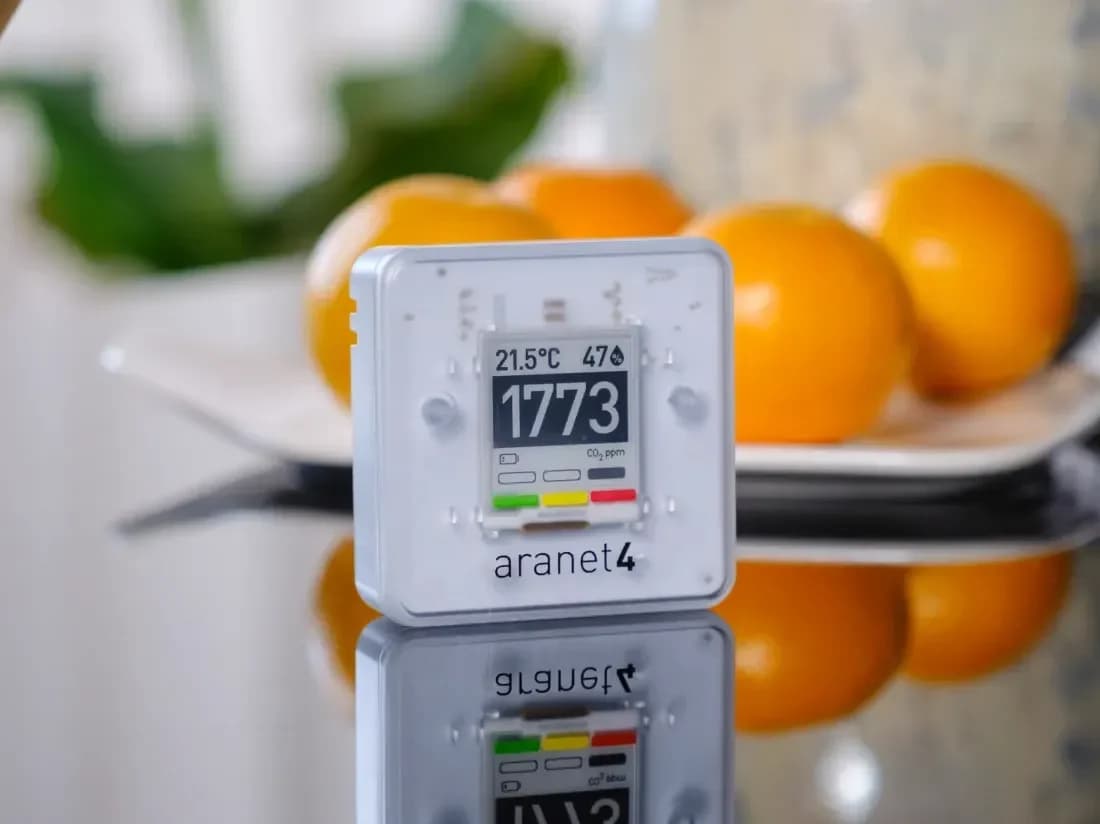
The Aranet4 HOME is our first choice if you mainly want to compare a closed bedroom with a ventilated one. Its e-ink screen shows CO2, temperature and humidity; pressure is available in the app and used to compensate the CO2 reading. It works out of the box without app setup, and the buzzer is disabled by default.
Aranet
A battery-powered, e-ink CO2 monitor with a true NDIR sensor and pressure compensation, plus temperature and humidity, that logs to a phone app over Bluetooth.
Comes in 2 versions: see which to buy
- CO2 (NDIR), temperature, relative humidity, air pressure (pressure shown in the app)
Aranet's datasheet lists CO2 accuracy as ±(30 ppm + 3% of reading), specified over 0–5000 ppm, 15–35°C and 0–80% relative humidity. Its battery estimate is about 2.8 years on alkaline AAs with Bluetooth on and a five-minute interval, at 20°C. That is an extrapolated maker estimate, not a guaranteed runtime.
Logging has two limits. At the default five-minute interval, the monitor retains 15 days; the manual says the app stores up to 90 days and exports CSV. Sync before changing batteries: removing them erases the device's history.
Buy HOME for standalone use. PRO adds the connection to an Aranet PRO base station. HOME's phone connection is Bluetooth, so choose View Plus if you want online readings while away. Neither particles nor VOCs are in HOME's sensor list.
Best CO2-focused alternative: INKBIRD IAM-T1
The IAM-T1 combines a Senseair NDIR sensor with a 2.13-inch e-ink display, temperature and humidity. Pressure is available through the app. Its adjustable CO2 threshold can trigger an inverted screen and buzzer, which makes it worth considering for a desk where you want a visible prompt.
INKBIRD lists 30 days of offline storage, Bluetooth syncing and app export, without specifying the export format. Sampling intervals are one, two, five or ten minutes, with one minute the default. Its comparison table lists no Wi-Fi; Bluetooth access is not an internet connection.
Resolve the battery claim before buying for long unattended use. The product page advertises 18 months on two AA batteries at a ten-minute interval, but the IAM-T1 column of its comparison table says four years. We would plan around the explicitly qualified 18-month claim. The FAQ recommends calibration every six months or after relocation; use INKBIRD's instructions for that procedure.
Best Wi-Fi monitor with radon: Airthings View Plus
View Plus suits a fixed room where you want several separate readings in one app. Its seven measurements include NDIR CO2, PM2.5, radon and VOCs, plus temperature, humidity and pressure. The 2.9-inch e-ink display shows up to four values; power comes from six AA batteries or USB-C.
Airthings
Airthings View Plus Radon and Air Quality Monitor
A seven-sensor home monitor (radon, PM2.5, NDIR CO2, VOCs, temperature, humidity and pressure) with an e-ink display, Wi-Fi, and either battery or USB-C power.
Comes in 4 versions: see which to buy
- Radon, PM2.5, CO2 (NDIR), VOC, temperature, humidity, air pressure
It connects over 2.4 GHz Wi-Fi, with Bluetooth for setup. Airthings describes its app as free, and its dashboard export instructions allow CSV downloads covering up to a year per export. USB-C also enables its hub function for compatible Airthings Wave monitors. Apple HomeKit is not supported.
The CO2 accuracy documents disagree. The product page says ±50 ppm ±3%; the help centre says ±30 ppm ±3%; the product sheet says ±50 ppm ±5%. Their qualifying temperature and measurement ranges also differ. We would ask Airthings which specification applies to the supplied unit rather than rank it by the most favorable number.
Allow approximately seven days for initial CO2 calibration. Its automatic baseline updates weekly, so a fresh setup is a poor basis for comparing monitors. Choose the single View Plus for this sensor set; View Plus Duo contains two View Plus monitors, while bundles can add a different device.
Best for local Home Assistant: AirGradient ONE
Choose the fully assembled Wi-Fi ONE, model I-9PSL, if you want local Home Assistant or Homey integration alongside NDIR CO2, particles and VOC/NOx indexes. It uses a Senseair S8 or S88 CO2 module, a small OLED and an LED bar that can be switched off. USB power is required; the power adapter is separate.
Choose the version deliberately. The DIY kit uses the same hardware but requires assembly and lacks the assembled model's warranty, certifications and test report. Its stated particle accuracy also differs. A cellular model is a separate option; it is not the Wi-Fi version covered here.
The sales page calls the dashboard subscription-free but also lists “12 months data platform / dashboard and API access.” Confirm the current cloud entitlement if that decides your purchase. Local Home Assistant support offers another way to collect data. The dashboard supports CSV export.
Offline display does not mean offline logging. AirGradient's storage documentation says ONE has no internal history storage and cannot save readings during Wi-Fi outages for later upload. Keep a networked recorder available if you need an uninterrupted history.
See the assembled ONE at AirGradient
Buying guide: turn readings into a useful room comparison
Read trends before colors. CO2 is measured in parts per million, or ppm. HSE describes CO2 readings as a broad guide to ventilation, not proof of “safe levels.” Its workplace guidance identifies readings consistently above 1500 ppm in an occupied room as evidence of poor ventilation. That is useful context, not a universal bedroom limit. NOAA's preliminary September 2026 Mauna Loa monthly average was 426.07 ppm; a distant observatory's average is not your room's calibration reference.
Place the sensor away from your breath. HSE recommends head height, away from windows, doors and air supplies, and over 50 cm from people. It also recommends repeated measurements while occupied, recording occupancy and ventilation conditions. Apply those principles to a seated desk or bedroom, following the monitor's own placement instructions.
Choose a representative position
Put the monitor at head height, away from windows, doors and air supplies, over 50 cm from people.
Record occupied conditions
Note the occupants and ventilation arrangement alongside the readings.
Compare repeated readings
Compare the trend under different ventilation conditions; avoid judging the room from one snapshot.
Check calibration assumptions. Aranet arrives factory calibrated, with automatic calibration disabled. Its manual says enabling automatic calibration requires around eight hours of fresh-air exposure each month. AirGradient's automatic baseline period is seven days and can be adjusted or disabled. Airthings uses the lowest weekly reading as its fresh-air baseline. If a room stays occupied and closed, ask the maker whether that baseline routine fits the location; don't recalibrate simply to make two displays agree.
Sampling changes battery life and history. Aranet's one-minute setting reduces its Bluetooth-on battery estimate to 0.9 years and device history to 3.5 days, versus 2.8 years and 15 days at five minutes. The battery estimates assume alkaline AAs at 20°C. INKBIRD's 18-month claim uses ten-minute sampling, not its one-minute default. Choose the interval before collecting a comparison and sync regularly.
Choose the measurement you need. HSE explains that air cleaners do not remove CO2 or improve ventilation. For particle filtration, see our best air purifiers; for moisture readings, see indoor humidity and hygrometers.
How we choose
We compared official product pages, datasheets, manuals and support documentation, with HSE guidance for interpreting ventilation readings and NOAA for outdoor context. Recommendations prioritize dedicated CO2 sensing, usable history, power, calibration and connection requirements. Published accuracy is a maker specification, not an independently verified result. Conflicting claims are identified above; we have no physical test results for these products. See How we choose for our editorial method.
Verdict
Get Aranet4 HOME for straightforward CO2 monitoring across rooms. Choose INKBIRD IAM-T1 for adjustable alerts and offline logs, View Plus for Wi-Fi with radon and particles, or the assembled AirGradient ONE for local Home Assistant data. Before ordering, match the exact version, calibration routine and logging requirements to where you will use it.
Frequently asked questions
What is the best CO2 monitor for a bedroom?
Our pick is the Aranet4 HOME: its e-ink screen works without a phone, it runs on AA batteries, and its buzzer is disabled by default. The Bluetooth app adds history and CSV export. Choose the Airthings View Plus if you also want Wi-Fi access and readings for particles and radon; choose AirGradient ONE if local Home Assistant integration matters most.
Is eCO2 the same as an NDIR CO2 measurement?
No. Sensirion's SGP30 documentation says its CO2-equivalent signal is calculated from ethanol and hydrogen measurements. NDIR measures infrared absorption by carbon dioxide itself; photoacoustic NDIR also measures CO2 directly, using the resulting pressure wave. For a ventilation monitor, look for a dedicated CO2 sensor and its published specification rather than trusting a CO2 label on the screen.
What is a good CO2 reading at home?
Use CO2 as a ventilation indicator, with occupied-room trends more useful than one snapshot. HSE's workplace guidance says readings consistently above 1500 ppm in an occupied room indicate poor ventilation; that is workplace guidance, not a universal household safety limit. NOAA's preliminary September 2026 Mauna Loa monthly average was 426.07 ppm, but it is not a calibration value for every backyard.
Can an air purifier lower CO2?
HSE explains that air-cleaning units remove contaminants but do not remove CO2 or improve ventilation. A particle reading and a carbon dioxide reading therefore answer different questions. If particles are part of your buying decision, View Plus and AirGradient ONE measure PM2.5 as well as CO2; Aranet4 HOME and INKBIRD IAM-T1 do not list a particle sensor.
Do these CO2 monitors work without Wi-Fi?
Aranet4 HOME and INKBIRD IAM-T1 show readings on their screens and transfer history over Bluetooth. View Plus uses Wi-Fi for its online data, with Bluetooth for setup. AirGradient ONE can display readings offline, but it has no internal history storage: without a working network connection to a recorder, you should expect gaps rather than later backfilling.