

Best picks
Best Humidifiers for Bedrooms: Canopy vs Carepod vs Levoit
Bedroom humidifiers compared on what EPA and the makers say matters: evaporative vs ultrasonic, white dust and water, cleaning, tank size and humidity control.
By thisHUSH EditorialUpdated November 2, 202610 min read1 picks
thisHUSH covers comfort, quiet and air-quality gear, not health. Nothing on this site is medical advice: for sleep, breathing or hearing concerns, talk to a doctor.
Our picks at a glance
For most bedrooms, the Canopy Bedside Humidifier 2.0 is the humidifier to get: it's evaporative, so there's no visible mist and, by EPA's account, no substantial mineral dust, and every part that touches water goes in the dishwasher. If you want a bigger tank and a humidistat, the Levoit Classic 300S holds 6 liters and has an auto mode that keeps the room at 40 to 50%. If you never want to buy a filter, the Carepod One is a filter-free ultrasonic with a stainless steel tank. Fill either ultrasonic with distilled water.
EPA's target is simple: keep indoor humidity below 60 percent, ideally between 30 and 50, and don't humidify above 50. Two of these three can't hold a set humidity level by themselves, so a hygrometer matters as much as the humidifier. Specs, manuals and EPA guidance checked November 1, 2026.
- 30 to 50%EPA's ideal indoor humidity range
- 50%The level EPA says not to humidify above
- 6 LLevoit Classic 300S tank, up to 60 hours on its low setting
Quick picks
| Pick | Best for | Type | Room size (maker) | Tank and runtime (maker) | Humidity control |
|---|---|---|---|---|---|
| Canopy Bedside Humidifier 2.0 | Best overall for bedrooms | Evaporative | Up to 500 sq ft | 2.5 L, 18 to 36 hours | None: runs until the tank is empty |
| Levoit Classic 300S | A bigger tank and auto humidity | Ultrasonic cool mist | 215 to 505 sq ft | 6 L, up to 60 hours on low | Auto mode: 40 to 50% or your target |
| Carepod One | No filter to buy | Ultrasonic cool mist | Up to 500 sq ft | 4 L, up to 30 hours | None listed: 3 mist settings and a timer |
Evaporative or ultrasonic: what EPA says
Tap a label to explore. You can also hover or use your keyboard.
Scroll across to see every column
Bars start at zero and share a scale within each column.
For portable humidifiers: empty the tank, wipe surfaces dry and refill daily. Clean every third day, including when using distilled water.
Source notes8 references
Ultrasonic humidifiers make cool mist using ultrasonic sound vibrations.
www.epa.gov — source for Ultrasonic humidifiers make cool mist using ultrasonic sound vibrations.Ultrasonic , which create a cool mist by means of ultrasonic sound vibrations.
Ultrasonic or impeller humidifiers efficiently disperse tap-water minerals; white dust may appear on surfaces.
www.epa.gov — source for Ultrasonic or impeller humidifiers efficiently disperse tap-water minerals; white dust may appear on surfaces.Researchers have documented that ultrasonic or impeller humidifiers are very efficient at dispersing minerals in tap water into the air. In addition, some consumers are bothered by a "white dust" that may appear on surfaces during use of these devices.
Evaporative humidifiers use a fan to blow air through a wet wick or other absorbent material, transmitting moisture invisibly.
www.epa.gov — source for Evaporative humidifiers use a fan to blow air through a wet wick or other absorbent material, transmitting moisture invisibly.Evaporative , which transmit moisture into the air invisibly by using a fan to blow air through a moistened absorbent material, such as a belt, wick, or filter.
EPA does not expect evaporative humidifiers to disperse substantial amounts of minerals.
www.epa.gov — source for EPA does not expect evaporative humidifiers to disperse substantial amounts of minerals.Steam vaporizer and evaporative humidifiers are not expected to disperse substantial amounts of minerals.
EPA recommends low-mineral water such as distilled water to prevent releasing minerals.
www.epa.gov — source for EPA recommends low-mineral water such as distilled water to prevent releasing minerals.Use water with low mineral content, such as distilled water, to prevent releasing minerals into the air.
EPA recommends bottled water labelled distilled; it still contains some minerals but likely less than most tap water.
www.epa.gov — source for EPA recommends bottled water labelled distilled; it still contains some minerals but likely less than most tap water.Use bottled water labeled "distilled." While distilled water still contains some mineral content, it will likely contain lower mineral content than most tap water.
EPA advises emptying the tank, wiping surfaces dry and refilling portable humidifiers daily.
www.epa.gov — source for EPA advises emptying the tank, wiping surfaces dry and refilling portable humidifiers daily.Empty the tank, wipe all surfaces dry, and refill the water in portable humidifiers daily to reduce any growth of microorganisms.
EPA advises cleaning portable humidifiers every third day.
www.epa.gov — source for EPA advises cleaning portable humidifiers every third day.Clean portable humidifiers every third day to reduce the buildup of scale and microorganisms.
The type decides what comes out of the humidifier besides water vapor, so start there.
Ultrasonic humidifiers "create a cool mist by means of ultrasonic sound vibrations." EPA says ultrasonic and impeller models "are very efficient at dispersing minerals in tap water into the air," and that some people notice a "white dust" on surfaces as a result. Its fix is low-mineral water: bottled water labeled "distilled," because bottled waters labeled "spring," "artesian" or "mineral" "have not been treated to remove mineral content." Demineralization cartridges help too, but EPA says how well they work "may vary widely," and white dust is the sign they aren't.
Evaporative humidifiers "transmit moisture into the air invisibly by using a fan to blow air through a moistened absorbent material, such as a belt, wick, or filter." EPA adds that evaporative and steam types "are not expected to disperse substantial amounts of minerals." The catch is the wick or filter, which you replace.
The makers line up with EPA. Canopy, the evaporative pick, says its humidifier "is compatible with tap water." Carepod says to fill the Carepod One "with distilled or filtered water," and Levoit's manual says, "We recommend using purified or distilled water."
Best for bedrooms: Canopy Bedside Humidifier 2.0
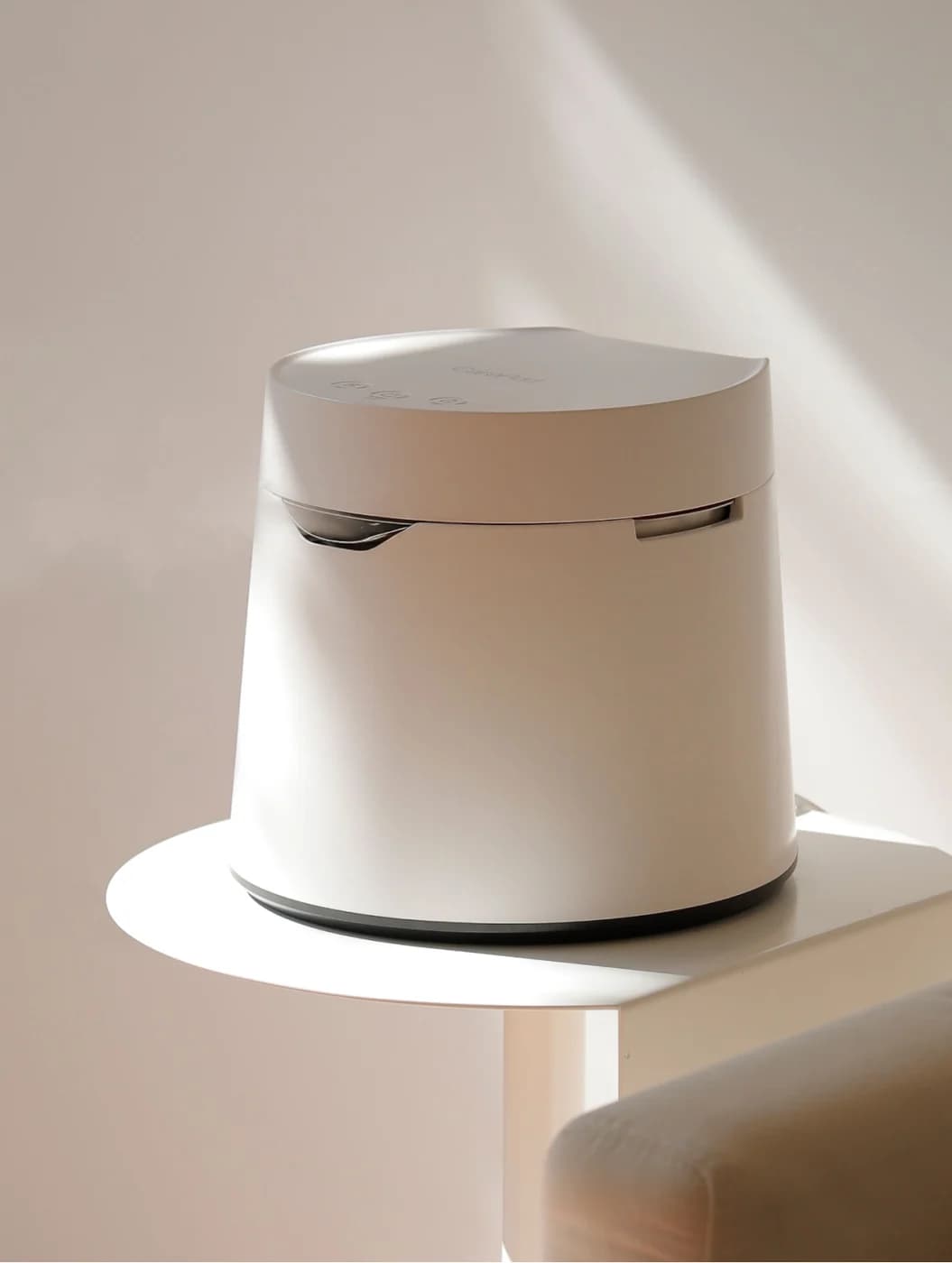
The Bedside 2.0 is sized for a nightstand (10 x 8.5 x 7 in, 3 lb) and rated by Canopy for rooms up to 500 sq ft. Water soaks into a MERV 5 filter and a fan evaporates it, so there's no mist, and its 2.5 L tank lasts between 18 and 36 hours, depending on the humidity in your room.
Cleaning is the selling point. In Canopy's words, "All parts that touch water go straight into the dishwasher: tank, tray, cap, grill." The fan body, which holds the electrical parts, stays out. Canopy says to replace the filter every 45 days and to let the tray and filter dry completely at least once a week. For the bedroom there's a dimmable red light, a soft night light, backlit controls and three soundscapes (White Noise, Soft Storm and Rolling Waves), plus aroma diffusion. The warranty is 12 months.
The catch: Canopy says it's "designed to run continuously until all of the water in the tank has been used." Its spec list has no humidistat and no noise or output figure, so pair it with a hygrometer and switch it off if the room reaches 50%.
See the Bedside Humidifier 2.0 at Canopy
Best for a bigger tank and auto humidity: Levoit Classic 300S
The Classic 300S is the pick if you want the humidifier to manage the level for you. Its humidity sensor drives an auto mode that "automatically adjusts mist levels to maintain 40–50% relative humidity or your customized target humidity level." The manual settings are Low, Medium and High, and the free VeSync app adds schedules, a target humidity and voice control.
Its 6 L tank is the largest here, rated for up to 60 hours on low, and it fills from the top. Levoit rates it for rooms of 215 to 505 sq ft and lists a noise level of 30 dB or less (without saying how far away), 26 W, 9.6 x 7.5 x 13.4 in and 4.3 lb. There's an optional night light and an aroma pad, and the warranty is 2 years limited.
As an ultrasonic, it's the type EPA flags for mineral dust, so use the purified or distilled water Levoit recommends. Its manual says to clean it every week by hand (no part goes in the dishwasher, and no detergents) and to descale it with white vinegar. There's no wick to replace, only a small water filter in the tank that you rinse during cleaning.
See the Classic 300S at Levoit
Best filter-free: Carepod One
The Carepod One is for people who don't want to buy filters: Carepod's page says "No Filter Required." It's an ultrasonic cool-mist unit with a 4 L stainless steel tank rated for up to 30 hours, three mist settings and a built-in timer, sized for up to 500 sq ft.
Carepod
Carepod One Stainless Steel Ultrasonic Humidifier
A filter-free ultrasonic cool-mist humidifier with a stainless steel tank that breaks down into three parts for cleaning, with three mist levels and a timer.
Comes in 7 versions: see which to buy
- 500 sq ft room
Cleaning means three parts: "the white wand, stainless steel tank, and inner lid." The stainless parts can go in the dishwasher or be boiled, and Carepod says to wash only the bottom half of the white wand, with mild dish soap and a soft sponge.
The trade-offs: no humidistat or auto mode is listed, Carepod's spec list gives no noise level, and as an ultrasonic it needs low-mineral water. Carepod says distilled or filtered; EPA's first choice is water labeled distilled.
Canopy vs Carepod vs Levoit
| Canopy Bedside 2.0 | Carepod One | Levoit Classic 300S | |
|---|---|---|---|
| Type | Evaporative | Ultrasonic | Ultrasonic |
| Water (maker) | Tap water | Distilled or filtered | Purified or distilled |
| Filter or wick | MERV 5 filter, every 45 days | None | No wick; small rinse-clean water filter in the tank |
| Dishwasher | Tank, tray, cap and grill | Stainless tank and lid | No: hand-clean only, per the manual |
| Tank and runtime | 2.5 L, 18 to 36 h | 4 L, up to 30 h | 6 L, up to 60 h on low |
| Humidity control | None | None listed | Auto mode, 40 to 50% or a set target |
| App | None listed | None listed | VeSync app |
| Noise figure in the specs | None | None | 30 dB or less |
| Night light | Red light and night light | Not listed | Optional night light |
The choice comes down to two questions: will you buy filters, and will you buy distilled water? Canopy needs the filters, Carepod the distilled water, and Levoit the distilled water plus a free app if you want schedules.
Buying guide
Set a target, then measure. EPA says to keep indoor humidity "below 60 percent (ideally between 30 and 50 percent)" and not to humidify "to indoor relative humidity levels exceeding 50 percent." It also gives the warning sign: "If water condenses on windows, walls, or pictures, relocate the humidifier, lower its humidistat setting, or reduce its use." Only the Levoit can hold a level by itself. With the Canopy or Carepod, put a hygrometer in the room; a basic one such as the TempPro TP50 lists humidity accuracy of plus or minus 2 to 3% and records the high and low. Our indoor humidity and hygrometer guide explains what to buy and where to put it.
Read room sizes as claims. All three quote a room size, but Canopy's and Levoit's spec lists give no output figure, and Carepod's appears only in a product-page graphic. A humidifier rated "up to 500 sq ft" in a draughty room won't behave like the same one in a small, closed bedroom.
Plan the cleaning. EPA's routine for portable humidifiers is to "Empty the tank, wipe all surfaces dry, and refill the water" daily and to clean them "every third day," following the maker's instructions for cleaning products. That's stricter than Levoit's weekly schedule, and it's the main reason dishwasher-safe parts matter.
Placement, including nurseries. Follow the manual. Levoit's is specific: a hard, flat, water-resistant surface at least 12 inches from walls, not directly on floors, carpets or rugs, with the mist "directed away from walls, furniture, bedding, and appliances," and the humidifier kept out of reach of children.
How we choose
We haven't lab-tested these humidifiers. Every pick comes from research:
- Type first. EPA's fact sheet on home humidifiers decides what we say about water and white dust for each design.
- Spec sheets and manuals. Tank size, runtime, room size, controls and cleaning come from each maker's product page and manual, linked in each section.
- Upkeep. Filters, cleaning steps and the water each maker asks for, because those are what you live with all winter.
- No health claims. We describe what a humidifier does to the room's humidity, not what it does for your body.
Our full method is on How we choose.
Verdict
The Canopy Bedside Humidifier 2.0 is the best humidifier for most bedrooms: evaporative, so tap water is fine and there's no mist, with dishwasher-safe parts and an 18- to 36-hour tank. Pair it with a hygrometer, because it runs until the tank is empty. Choose the Levoit Classic 300S for a 6 L tank and an auto mode that holds 40 to 50%, or the Carepod One if you'd rather never buy a filter. Use distilled water in both ultrasonics.
Sources
Specs, manuals and EPA guidance checked November 1, 2026:
- EPA: Use and care of home humidifiers and A brief guide to mold, moisture and your home
- Canopy: Bedside Humidifier 2.0
- Carepod: Carepod One
- Levoit: Classic 300S and its user manual (PDF)
- TempPro: TP50 thermometer and hygrometer
Frequently asked questions
What humidity should I set a humidifier to?
EPA's guidance is to keep indoor humidity below 60 percent, ideally between 30 and 50 percent, and its humidifier fact sheet says not to humidify above 50 percent. The Levoit Classic 300S's auto mode holds 40 to 50% or a target you set. The Canopy and Carepod have no humidistat, so check a hygrometer. If water condenses on windows or walls, EPA says to move the humidifier, lower its setting or use it less.
Do you need distilled water in a humidifier?
For ultrasonic and impeller types, EPA recommends water labeled distilled, because those designs are very efficient at dispersing tap-water minerals into the air, which can leave white dust on surfaces. Evaporative and steam humidifiers aren't expected to disperse substantial amounts of minerals. In line with that, Canopy, an evaporative unit, says tap water is fine, while Carepod and Levoit, both ultrasonic, tell you to use distilled, filtered or purified water.
Canopy or Carepod: which is easier to clean?
Both go in the dishwasher. Every Canopy part that touches water (tank, tray, cap and grill) is dishwasher safe, though the fan body isn't, and its filter needs replacing every 45 days. The Carepod One breaks down into three parts, its stainless steel parts can go in the dishwasher or be boiled, and there's no filter to replace. You wash only the bottom half of its white wand, by hand.