Explainer
White vs Pink vs Brown Noise: What's Actually Different, and Which Machines Play Each
White, pink and brown noise differ in one thing: how their energy is spread across frequencies. The acoustics in plain words, and which machines play each.
By thisHUSH EditorialUpdated November 2, 20268 min read2 picks
thisHUSH covers comfort, quiet and air-quality gear, not health. Nothing on this site is medical advice: for sleep, breathing or hearing concerns, talk to a doctor.
Our picks at a glance
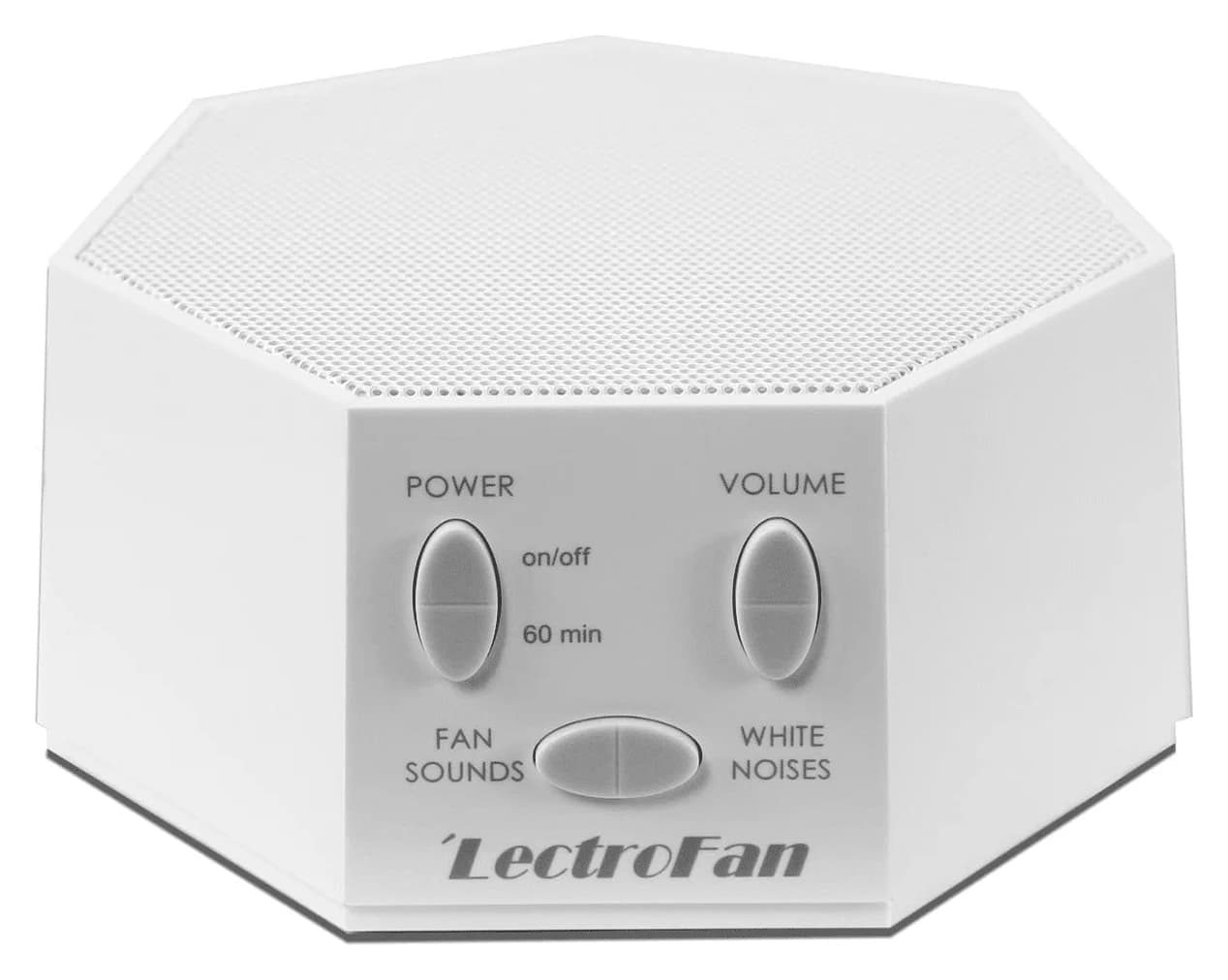
White, pink and brown noise are all random, hiss-like noise. The only difference is how their energy is spread across frequencies: white noise has equal power per hertz, pink noise has equal power per octave, and brown noise falls away faster still, so it's dominated by low rumble. If you want to hear all three on one machine, the LectroFan Classic lists white, pink and brown noise among its 20 sounds.
This page sticks to the acoustics, the definitions standards bodies use, and the makers' own sound lists. Definitions and sound lists checked November 1, 2026.
- 0 dBWhite noise: its spectral density stays flat at every frequency
- -3 dBPink noise: density falls about 3 dB per octave, so each octave has equal power
- -6 dBBrown noise: density falls about 6 dB per octave
The short version
| Noise | Definition | Energy spread | Sounds like |
|---|---|---|---|
| White | Equal power per hertz (ATIS) | Flat density, so every higher octave carries twice the power | Bright hiss, like static |
| Pink | Equal power per octave (ATIS) | Density falls about 3 dB per octave | Softer, more even hiss |
| Brown (also "red" or "Brownian") | Density falls about 6 dB per octave (AES) | Most energy in the lows | Deep rumble |
Tap a label to explore. You can also hover or use your keyboard.
Scroll across to see every column
| Option | Power distribution | Density as frequency rises |
|---|---|---|
White noiseEqual power per hertzWhite noise has equal power per hertz over the specified frequency band. Its power spectral density is flat. Sources: 1: ATIS defines white noise as having equal power per hertz over the specified frequency band., 2: IEEE describes white noise as having flat power spectral density. | Equal power per hertz | Flat |
Pink noiseEqual power per octavePink noise has equal power per octave. Its power spectral density decreases by 3 dB per octave as frequency rises. Sources: 3: ATIS defines acoustic pink noise as having equal power per octave., 4: IEEE says pink-noise power spectral density falls by three decibels per octave as frequency increases. | Equal power per octave | Falls 3 dB per octave |
Brown noiseA steeper density fallBrown-noise power spectral density is proportional to inverse frequency squared. It falls by 6 dB per octave as frequency rises. Sources: 5: IEEE says brown-noise power spectral density falls by six decibels per octave and is proportional to inverse frequency squared. | Density follows inverse frequency squared | Falls 6 dB per octave |
Bars start at zero and share a scale within each column.
Read the density column from low frequency toward high frequency. These are relative spectral trends; listening volume and sleep effects require separate evidence.
Source notes5 references
ATIS defines white noise as having equal power per hertz over the specified frequency band.
glossary.atis.org — source for ATIS defines white noise as having equal power per hertz over the specified frequency band.White noise has equal power per hertz over the specified frequency band.
IEEE describes white noise as having flat power spectral density.
technav.ieee.org — source for IEEE describes white noise as having flat power spectral density.White noise has a flat power spectral density across all frequencies, making it the reference case.
ATIS defines acoustic pink noise as having equal power per octave.
glossary.atis.org — source for ATIS defines acoustic pink noise as having equal power per octave.In acoustics, noise in which there is equal power per octave.
IEEE says pink-noise power spectral density falls by three decibels per octave as frequency increases.
technav.ieee.org — source for IEEE says pink-noise power spectral density falls by three decibels per octave as frequency increases.Pink noise, also called 1/f noise, has a power spectral density that decreases by 3 dB per octave as frequency increases, so that equal-width logarithmic frequency bands carry equal power.
IEEE says brown-noise power spectral density falls by six decibels per octave and is proportional to inverse frequency squared.
technav.ieee.org — source for IEEE says brown-noise power spectral density falls by six decibels per octave and is proportional to inverse frequency squared.Brown noise, derived from Brownian motion, has a power spectral density that falls by 6 dB per octave, proportional to 1/f².
White noise: equal power per hertz
The telecom glossary maintained by ATIS (the Alliance for Telecommunications Industry Solutions) defines white noise as noise with "a frequency spectrum that is continuous and uniform over a specified frequency band," and adds that it "has equal power per hertz." The Audio Engineering Society's (AES) reference puts it in light terms: white noise "contains all audible frequencies distributed uniformly throughout the spectrum," like white light.
Here's the catch that explains how it sounds. We hear pitch in octaves, and every octave spans twice as many hertz as the one below it: 1,000 to 2,000 Hz is 1,000 Hz wide, while 2,000 to 4,000 Hz is 2,000 Hz wide. With equal power in every hertz, each higher octave holds twice the power of the one below it, about 3 dB more. That tilt toward the treble is why white noise sounds bright and hissy.
Pink noise: equal power per octave
ATIS defines pink noise, "in acoustics," as noise "in which there is equal power per octave." To get there, its power density has to fall as frequency rises: AES lists pink noise as "-3 dB/oct decreasing noise density (but, equal power per octave," with power "proportional to 1/frequency." Every octave, from the lowest bass to the highest treble, carries the same power, so pink noise sounds more even and less sharp than white.
Brown noise: steeper still
AES lists "red noise also called brown noise or Brownian noise after Robert Brown" at "-6 dB/oct decreasing density," with power "proportional to 1/frequency-squared" and "most amount of low frequency energy." So the "brown" isn't a color: it's Robert Brown, after whom Brownian motion is named. With density falling 6 dB per octave, the power in each octave drops about 3 dB as you go up, so brown noise is weighted toward the bass and sounds like a deep rumble.
Source: ATIS Telecom Glossary and the AES Pro Audio Reference
Put side by side, relative to the 1,000 to 2,000 Hz octave, the power in a low and a high octave works out like this (each octave step changes white by about +3 dB and brown by about -3 dB):
| Octave | White | Pink | Brown |
|---|---|---|---|
| 250 to 500 Hz (two octaves down) | About 6 dB less | Same | About 6 dB more |
| 1,000 to 2,000 Hz (reference) | Reference | Reference | Reference |
| 4,000 to 8,000 Hz (two octaves up) | About 6 dB more | Same | About 6 dB less |
Where fan sound fits
SNOOZ calls its real fan's output "natural, non-looping white noise." What you hear is moving air, and its character depends on the fan and its housing. The Yogasleep Dohm Classic's collar "shifts the tone," and SNOOZ says you can adjust the SNOOZ Pro's tone "from a light, airy fan sound (similar to a table fan) to a deep, low-pitched hum (similar to an airplane cabin)." Turning a fan machine "deeper" changes its tone; neither maker lists brown noise by name.
Which machines play each
From each maker's own sound list:
| Machine | White | Pink | Brown | Notes |
|---|---|---|---|---|
| LectroFan Classic | Yes | Yes | Yes | Ten noise variations "including pink and brown," plus ten fan sounds |
| LectroFan Micro2 | Yes | Yes | Yes | Four variations of white, pink and brown noise; battery |
| Loftie Clock | Yes | Not listed | Yes | "White and brown noise" among 100+ sounds on the clock |
| Hatch Baby | Yes | Yes | Not listed | Hatch's FAQ compares its white and pink noise |
| Yogasleep Hushh 2 | Yes | Not listed | Not listed | Six sounds, including white noise and the Dohm fan sound |
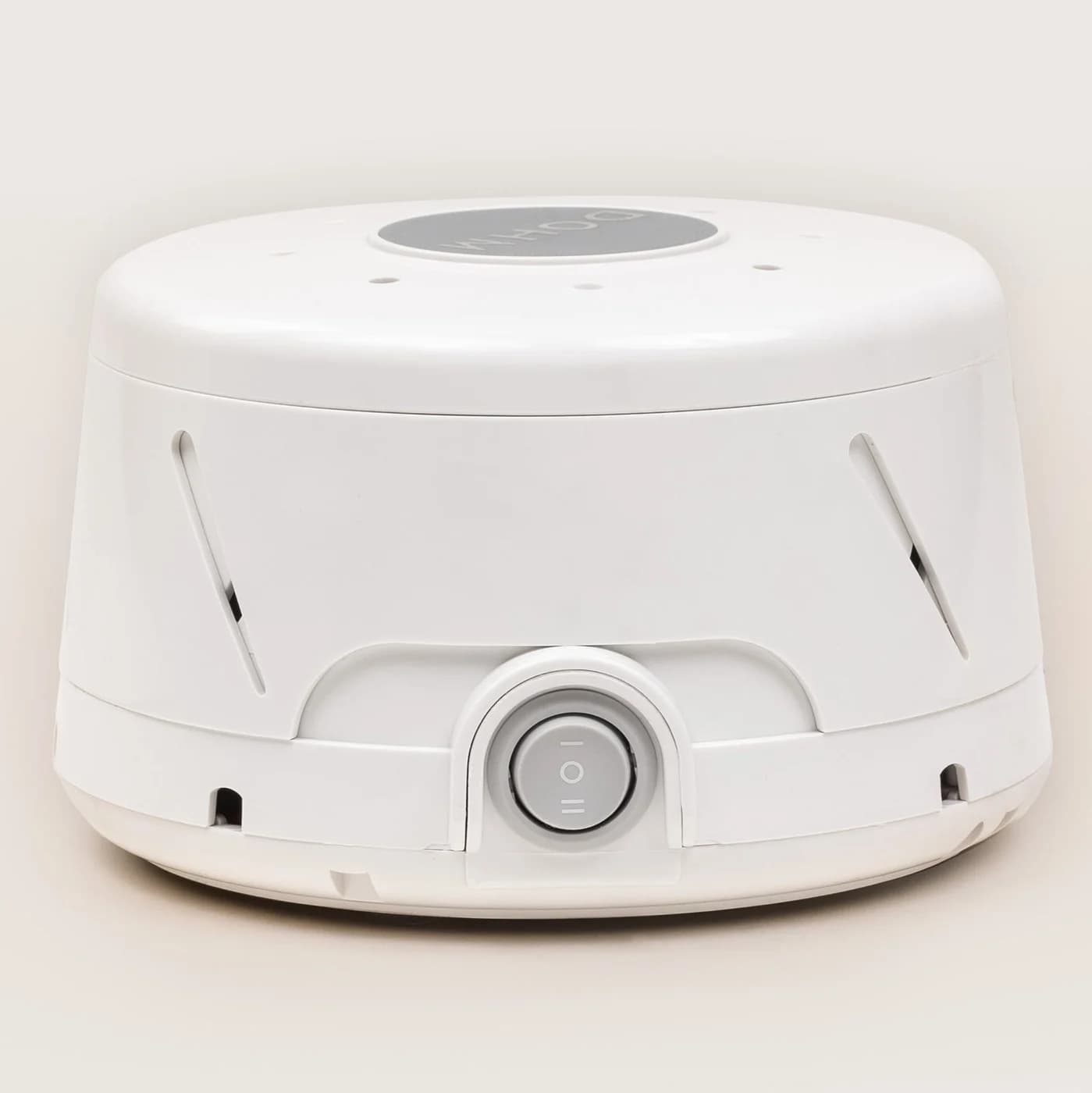
| Yogasleep Dohm Classic | Yes (real fan) | No | No | Real fan; adjustable tone |
| SNOOZ Pro | Yes (real fan) | No | No | Real fan; tone knob from airy to low hum |
| Ozlo Sleepbuds 2 | Yes | Not listed | Not listed | Masking content "(think, white noise, ocean waves, babbling brook, etc)" |
"Not listed" means the maker's page doesn't name it, not that the device can't play it. Sleep headphones that stream Bluetooth audio, such as the Ozlo Sleepbuds 2 or the SleepPhones Wireless headband, play whatever noise track your phone plays.
How to compare them yourself
Our noise guides compare what each sound machine can play, never what a noise color does for you. If you're choosing, the practical questions are:
- Does the machine list the color you want by name? "White noise machine" is a category name, not a promise of pink or brown noise. Of the machines above, only the LectroFans list all three.
- Can you switch between them? A digital machine lets you try white, pink and brown in seconds; a fan machine gives you one sound with a tone control.
- Does it loop? ASTI describes the LectroFan Classic's sounds as "non-repeating," and fan machines never loop because the sound is air.
For full picks, power, timers and nursery guidance, see our best white noise machines. For sound you wear instead of play into the room, see best sleep earbuds.
How we choose
We haven't measured these sounds. The definitions come from the ATIS Telecom Glossary and the Audio Engineering Society's Pro Audio Reference; the octave arithmetic follows directly from them. Each machine's sounds come from its maker's own sound list or FAQ, checked November 1, 2026. Our method is on How we choose.
Verdict
White, pink and brown noise are the same kind of random sound with different tilts: white is flat per hertz and bright, pink is flat per octave and even, brown falls off fastest and rumbles. If you want to choose among all three, the LectroFan Classic (or the battery Micro2) lists them by name. If you just want steady fan sound you can make brighter or deeper, a Dohm Classic or SNOOZ Pro does that without any digital audio.
LectroFan
LectroFan Classic White Noise and Fan Sound Machine (White)
A compact digital sound machine from Adaptive Sound Technologies with 10 fan sounds and 10 non-repeating noise variations from brown through pink to white, powered over USB.
Comes in 5 versions: see which to buy
- 20 sounds
Yogasleep
Yogasleep Dohm Classic Fan-Based Sound Machine (White)
Yogasleep's original fan-based sound machine: a real fan motor inside an adjustable housing makes a steady, non-looping rush of air, with two speeds, a rotating cap for volume and a collar for tone.
Comes in 7 versions: see which to buy
Sources
Definitions and sound lists checked November 1, 2026:
- ATIS Telecom Glossary: white noise and pink noise
- Audio Engineering Society: Pro Audio Reference, "noise color"
- Adaptive Sound Technologies: LectroFan Classic and LectroFan Micro2
- Yogasleep: Dohm Classic and Hushh 2
- SNOOZ: SNOOZ Pro
- Loftie: Loftie Clock
- Hatch: Hatch Baby
- Ozlo: Sleepbuds 2
- SleepPhones: SleepPhones Wireless
Frequently asked questions
What is brown noise?
Brown noise, also called red or Brownian noise, is random noise whose power density falls by about 6 dB with every octave you go up in frequency, according to the Audio Engineering Society's reference. Most of its energy sits in the low frequencies, so it sounds like a deep rumble rather than a hiss. The name comes from Robert Brown and Brownian motion, not from the color.
Is pink noise the same as white noise?
No. White noise has equal power per hertz, so each octave holds twice the power of the octave below it, which makes it sound bright and hissy. Pink noise has equal power per octave, so its density falls about 3 dB per octave and it sounds more even and less sharp. Many digital sound machines, such as the LectroFan Classic, play both.
Can a fan-based sound machine play brown noise?
Not as such. A fan machine like the Yogasleep Dohm Classic or SNOOZ Pro makes the sound of moving air, and its tone control shifts that sound between brighter and deeper. SNOOZ describes its range as running from a light, airy fan sound to a deep, low-pitched hum. For brown noise by name, choose a digital machine whose sound list includes it, such as the LectroFan Classic or Micro2.