

Best picks
Best Radon Detectors
Measurement Windows, Calibration and Data
Choose a radon detector by its display, measurement windows, power and data export. Compare current Airthings models and EcoQube Flex with EPA testing guidance.
By thisHUSH EditorialUpdated November 2, 20268 min read5 picks
Our recommendation: Airthings Corentium Home 2
Best for most homes
Limit: The original Corentium Home is radon-only; Home 2 adds temperature, humidity and connectivity.
On this page · Our picks at a glance
Our picks at a glance
- 1
Choose for: Best for most homes
Check before buying: The original Corentium Home is radon-only; Home 2 adds temperature, humidity and connectivity.
- 2
Choose for: Best for radon over Wi-Fi
Check before buying: Its direct 2.4 GHz Wi-Fi connection suits checking readings while away; it does not support a 5 GHz-only network.
- 3
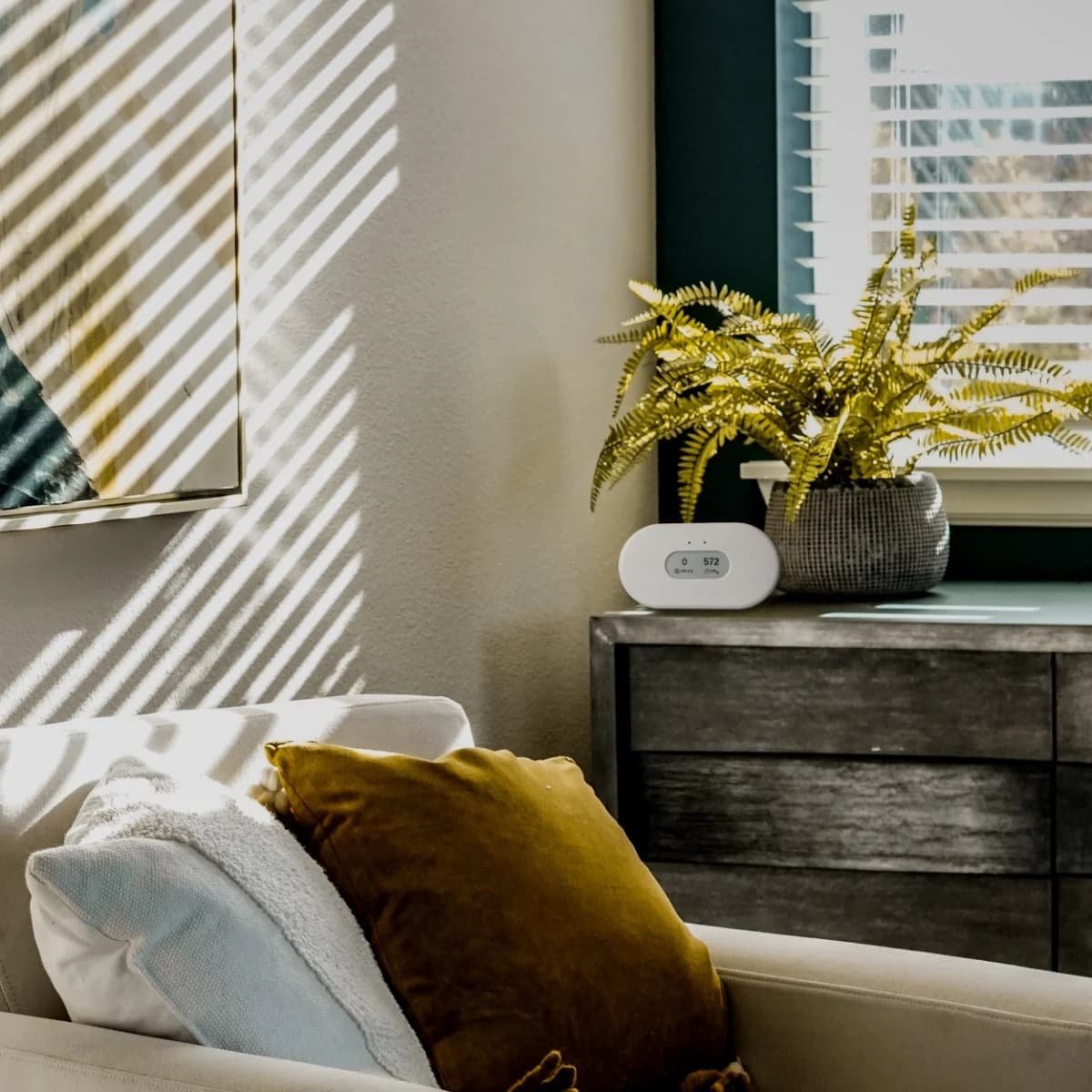
Choose for: Best multisensor monitor
Check before buying: Airthings describes the View models' radon technology as passive diffusion with alpha spectrometry; additional sensors are not evidence of better radon accuracy.
Show all 5 picks
- 4
Choose for: Best Airthings add-on with CO2
Check before buying: Without a hub, your phone must be nearby to sync current readings; a USB-powered View hub enables remote access.
- 5
Choose for: Best for faster on-screen trends
Check before buying: Bluetooth syncing does not provide live remote access.
About this guide
thisHUSH covers comfort, quiet and air-quality gear, not health. Nothing on this site is medical advice: for sleep, breathing or hearing concerns, talk to a doctor.
For most homes, our best radon detector pick is Airthings Corentium Home 2: it displays averages without an app and adds optional Bluetooth history. Choose View Radon for direct Wi-Fi access, View Plus for additional air measurements, or EcoQube Flex for faster on-screen trends. First-display speed is a shopping feature; use the EPA testing procedure to decide what a result means.
Quick picks and comparison
Compare specifications and all conditions
Corentium Home 2 — most homes
- Display and measurements
- LCD; radon, temperature, humidity
- First radon result
- 24-hour average after a full day
- Access and export
- Bluetooth; hub for remote access; synced CSV
All specifications
- Power and maker-rated life
- 2 AA; estimates differ by document and mode, below
View Radon — direct Wi-Fi
- Display and measurements
- E-ink; radon, temperature, humidity
- First radon result
- Startup time not specified in retrieved sheet; hourly sampling
- Access and export
- 2.4 GHz Wi-Fi; dashboard CSV
All specifications
- Power and maker-rated life
- 6 AA or USB; feature text says up to 2 years, specs say 3
View Plus — multisensor
- Display and measurements
- E-ink; radon, PM2.5, CO2, VOCs, temperature, humidity, pressure
- First radon result
- Startup time not specified in retrieved sheet; hourly sampling
- Access and export
- 2.4 GHz Wi-Fi; dashboard CSV
All specifications
- Power and maker-rated life
- 6 AA or USB-C; up to 2 years
Wave Plus — Airthings add-on
- Display and measurements
- Glow ring; radon, CO2, VOCs, temperature, humidity, pressure
- First radon result
- Startup time not specified in retrieved manual; hourly radon updates
- Access and export
- Bluetooth; hub for remote access; dashboard CSV
All specifications
- Power and maker-rated life
- 2 AA; 16 months Bluetooth / 18 months SmartLink
EcoQube Flex — faster trends
- Display and measurements
- E-ink; radon, with highs and lows
- First radon result
- 10–15 minutes; first reliable result within an hour
- Access and export
- Bluetooth; no live remote access; CSV unconfirmed
All specifications
- Power and maker-rated life
- 2 AA; up to 7 years offline / about 2 years with regular syncing
Full comparison table
Swipe to compare. Row labels stay visible.
| Detector / pick | Display and measurements | First radon result | Access and export | Power and maker-rated life |
|---|---|---|---|---|
| Corentium Home 2 — most homes | LCD; radon, temperature, humidity | 24-hour average after a full day | Bluetooth; hub for remote access; synced CSV | 2 AA; estimates differ by document and mode, below |
| View Radon — direct Wi-Fi | E-ink; radon, temperature, humidity | Startup time not specified in retrieved sheet; hourly sampling | 2.4 GHz Wi-Fi; dashboard CSV | 6 AA or USB; feature text says up to 2 years, specs say 3 |
| View Plus — multisensor | E-ink; radon, PM2.5, CO2, VOCs, temperature, humidity, pressure | Startup time not specified in retrieved sheet; hourly sampling | 2.4 GHz Wi-Fi; dashboard CSV | 6 AA or USB-C; up to 2 years |
| Wave Plus — Airthings add-on | Glow ring; radon, CO2, VOCs, temperature, humidity, pressure | Startup time not specified in retrieved manual; hourly radon updates | Bluetooth; hub for remote access; dashboard CSV | 2 AA; 16 months Bluetooth / 18 months SmartLink |
| EcoQube Flex — faster trends | E-ink; radon, with highs and lows | 10–15 minutes; first reliable result within an hour | Bluetooth; no live remote access; CSV unconfirmed | 2 AA; up to 7 years offline / about 2 years with regular syncing |
“Not specified” concerns first-result timing, not the sampling interval. Sources: the Home 2 sheet, View Radon sheet, View Plus sheet, Wave Plus manual, Flex guide and Airthings export instructions.
Best for most homes: Airthings Corentium Home 2
The Corentium Home 2 works independently of your phone; its screen offers 24-hour, 7-day, 30-day and long-term radon averages, with the full set of views available after 30 days. The original Corentium Home is radon-only; Home 2 adds temperature, humidity and connectivity.
Check the exact version: the sheet identifies model 325, with US/Europe SKU 3250 and Canada SKU 3253, but the US store page's structured data says SKU 3255. Those identifiers disagree; confirm the supplied version before ordering rather than assuming the codes are interchangeable.
Battery estimates also conflict: the sheet gives up to 3 years unconnected, 2 on Bluetooth and 3 on SmartLink; the offline/connected help page says 3.5, 1.5 and 3 years, respectively. The stronger reason to choose it is the standalone screen plus optional saved history.
See Corentium Home 2 at Airthings
Best for radon over Wi-Fi: Airthings View Radon
View Radon, model 2989, SKU 989, combines a configurable e-ink screen with radon, temperature and humidity. Its direct 2.4 GHz Wi-Fi connection suits checking readings while away; it does not support a 5 GHz-only network.
It runs on batteries or USB, but using it as a hub for compatible Airthings monitors requires USB power. Airthings' feature text says up to 2 years on batteries; its technical specifications and sheet say up to 3 years. Read that as an unresolved estimate, not a reason to promise a particular replacement interval.
Best multisensor monitor: Airthings View Plus
The View Plus, model 2960, adds PM2.5, NDIR CO2, VOCs and pressure to radon, temperature and humidity. Its e-ink display can show up to four values, and it has direct Wi-Fi.
Airthings
A seven-sensor home monitor (radon, PM2.5, NDIR CO2, VOCs, temperature, humidity and pressure) with an e-ink display, Wi-Fi, and either battery or USB-C power.
Check package and model options
- Radon, PM2.5, CO2 (NDIR), VOC, temperature, humidity, air pressure
Buy it when those extra measurements matter in the same room. Airthings describes the View models' radon technology as passive diffusion with alpha spectrometry; additional sensors are not evidence of better radon accuracy. For separate CO2 shopping, see our CO2 monitor guide.
Best Airthings add-on with CO2: Airthings Wave Plus
The US Wave Plus page identifies model/SKU 2910 and currently marks it in stock. Its six measurements include CO2 and VOCs alongside radon, temperature, humidity and pressure; the visual indicator is a glow ring rather than a numeric screen.
Choose it for another room in an existing Airthings system. Without a hub, your phone must be nearby to sync current readings; a USB-powered View hub enables remote access. The manual says it stores readings locally for up to 80 days, so make syncing a habit. The 16-month Bluetooth / 18-month SmartLink estimates explain why its headline “1.5-year” battery claim needs context.
Best for faster on-screen trends: Ecosense EcoQube Flex
EcoQube Flex, model EF100, uses a pulsed ionization chamber and works offline. The product page advertises a first reading in 10 minutes; the manual says 10–15 minutes, then separately specifies a first reliable result within an hour. Its “real-time” mode is a 60-minute rolling average updated every 10 minutes.
That makes it our alternative for watching shorter trends on the device. It also offers 24-hour, 72-hour, 7-day, 30-day and cumulative long-term views, plus days measured. It uses the Ecosense app, distinct from the EcoQube app; existing EcoQube app accounts can sign in with the same email and password. Bluetooth syncing does not provide live remote access. The guide documents one year on-device storage plus cloud backup; it does not establish a CSV export workflow.
Buying guide
First reading, rolling average and completed test
EPA expresses radon concentration in picocuries per liter of air, or pCi/L. The monitor codes above identify devices; the cited sheets describe sensing technology rather than supplying a separate sensor-part shopping code.
A rolling average moves forward as new data replaces older data. Flex's cumulative view instead averages the data since monitoring began. Home 2's first average arrives after 24 hours, with 7-day and 30-day views among its later windows. Flex's earlier display still represents an average, not an instantaneous reading.
EPA defines short-term tests as two to 90 days and long-term tests as more than 90 days. A longer test is more likely to represent the year-round average. Keep these distinct from a maker's startup or precision specification:
First display
Home 2: 24 hours. Flex: 10–15 minutes, with a first reliable result specified within an hour.
Rolling window
Home 2 adds 7-day and 30-day views; Flex's real-time mode averages 60 minutes.
Completed test
EPA: short-term tests last two to 90 days; long-term tests last more than 90 days. Follow device instructions.
Accuracy and calibration: compare the conditions
Home 2's sheet specifies precision within 10% after 4 days at 10 pCi/L or 7 days at 5.4 pCi/L. The View sheets state typical 7-day-average accuracy of ±10% at 5.4 pCi/L after 30 days of continuous measuring, and ±5% for a two-month average. Airthings' general sensor explanation also qualifies its figures by that settling period, whereas the Wave Plus product page omits the qualification.
Flex specifies ±10% at 10 pCi/L after 10 hours, at 95% confidence. These differently stated figures do not establish an accuracy winner.
Airthings calls its radon process acclimatization rather than traditional calibration. Separately, View Plus and Wave Plus CO2/VOC sensors need about 7 days initially. That is a different process from collecting a radon baseline; it does not replace EPA's follow-up procedure.
Placement and keeping a useful record
EPA says to test the lowest lived-in level, in a regularly used room rather than a kitchen or bathroom, at least 20 inches above the floor, away from drafts, high heat, high humidity and exterior walls. Home 2's sheet specifies more than 20 inches above the floor and at least 3 feet from doors, windows or vents; use its stricter placement instruction. For humidity-only shopping, see our hygrometer guide.
- Yes: Choose the lowest regularly occupied level and a stable, undisturbed position.
- Yes: Keep Home 2 more than 20 inches above the floor and at least 3 feet from doors, windows and vents.
- No: Avoid kitchens, bathrooms, drafts, heat and high humidity for the EPA testing placement.
Sync before moving rooms or changing batteries. Home 2's offline history becomes inaccessible after a new measurement or battery removal; its new-location instructions say to sync fully first. Flex likewise uses separate monitoring sessions to preserve each room's synced history. An Airthings CSV uses UTC timestamps and covers up to one year per export, with adjoining exports for longer periods.
EPA procedure and next actions
Follow the Citizen's Guide, alongside the device instructions. For a 2- or 3-day short-term test, EPA says to close windows and outside doors at least 12 hours before starting and keep them closed as much as possible during the test. It also says to avoid unusually severe storms or high winds for those short tests.
- Initial short-term result at or above 4 pCi/L: take a follow-up long-term or second short-term test. If the first result is more than twice that action level, EPA says to take the second short-term test immediately.
- Long-term result at or above 4 pCi/L: EPA says to fix the home. After a second short-term test, consider fixing if the average of both tests is 4 pCi/L or higher.
- Between 2 and 4 pCi/L: EPA says to consider fixing. Use the agency's current guidance, rather than treating an app color as a completed testing procedure.
Variants that can mislead a purchase
Wave Radon is not Wave Plus or View Radon. Its US page says it is no longer available on airthings.com, though selected retailers still carry it; Airthings directs shoppers to View Radon. View hub specifications exclude first-generation Wave Radon units with serials beginning 2900, so check an older unit before planning a hub system.
EcoQube Flex is not EcoQube. The maker's comparison lists Flex as battery-powered Bluetooth with a screen, and EcoQube as a plug-in Wi-Fi model with an LED indicator and remote access. Match the full name to the connection you need.
How we choose
Specs, availability and support wording checked November 2, 2026. We compared official maker pages, sheets and instructions, with EPA guidance for test interpretation. These are research-based recommendations; thisHUSH has not conducted physical product testing. Awards prioritize readable averages, access from away, power and retained history; they do not rank sensitivity slogans or unmatched accuracy figures. Wave Radon is explained for existing owners and older listings rather than recommended as a new purchase. See how we choose.
Verdict
Start with Corentium Home 2 for a screen and optional history, after checking its version identifiers. Choose View Radon for direct Wi-Fi, View Plus for additional measurements in that room, Wave Plus to extend an Airthings hub system, or EcoQube Flex for shorter on-screen trends. Buy the data access you will use, then follow the stated measurement procedure.
Frequently asked questions
What is the best radon detector without Wi-Fi?
Our default is Corentium Home 2: its screen works without an app, and Bluetooth is optional for graphs and saved history. EcoQube Flex also works offline and offers an earlier first display, with Bluetooth for syncing. Neither provides live remote access on its own; Home 2 can gain that through an Airthings hub. Choose by the history you want to keep as well as the screen.
Does a first radon reading mean the test is finished?
No. Corentium Home 2 first reports a 24-hour average after a full day; EcoQube Flex starts displaying readings within 10–15 minutes, but its manual separately specifies a first reliable result within an hour. EPA describes short-term tests as lasting two to 90 days and long-term tests as more than 90 days. Follow the device instructions and EPA follow-up procedure rather than treating the first number as a completed test.
What is the difference between Airthings Wave Plus and Wave Radon?
Wave Plus measures radon, CO2, VOCs, temperature, humidity and pressure. Wave Radon measures radon, temperature and humidity. Both use Bluetooth for nearby access, with compatible hubs enabling remote access. Airthings still lists Wave Plus in stock on its US page, while its Wave Radon page says that model is no longer available on airthings.com but remains at selected retailers. View Radon is the replacement Airthings points shoppers toward.
Can I export radon detector readings?
Airthings documents CSV export through its web dashboard after data is synced to your account. Its export instructions allow up to one year per export and say timestamps are in UTC; longer periods require adjoining exports. Corentium Home 2 has no offline export. EcoQube Flex documents local storage and cloud history, but we could not confirm a CSV export workflow in its cited guide, so check that requirement before buying.
Should I always wait months before following up a high reading?
No. EPA says an initial short-term test result at or above 4 pCi/L needs a follow-up test. If that first result is more than twice its action level, EPA says to take a second short-term test immediately. A maker's recommendation to collect a longer baseline does not replace that procedure. Use the result from a properly conducted test and follow EPA's decision steps.
Best for most homes
Airthings Corentium Home 2
Related guides
Comparison · air monitors
Aranet4 HOME vs PRO: Logging, Bluetooth and Which Model to Buy
Choose Aranet4 HOME or PRO with a clear comparison of Bluetooth, logging, export and remote access, plus regional variants and the base station you may need.
Updated November 2, 2026Read
Best picks · air monitors
Best CO2 Monitors for Bedrooms and Home Offices: NDIR vs eCO2
Best CO2 monitors for bedrooms and home offices, compared on real sensors, logging, calibration and power, with clear picks and the eCO2 buying trap explained.
Updated November 2, 2026Read
Buying guide · air monitors
Indoor Humidity Levels and the Best Hygrometers to Measure Them
What a hygrometer measures, EPA's 30 to 50% indoor humidity range, and four hygrometers and air monitors compared on stated accuracy, logging and placement.
Updated November 2, 2026Read