

Comparison
Compressor vs Desiccant Dehumidifiers
Temperature, Power and Drainage
Compare compressor and desiccant dehumidifiers by temperature, capacity ratings, power, noise and drainage, with US model picks and a complete buying checklist.
By thisHUSH EditorialUpdated November 3, 20268 min read
On this page · Quick picks: match the installation first
About this guide
thisHUSH covers comfort, quiet and air-quality gear, not health. Nothing on this site is medical advice: for sleep, breathing or hearing concerns, talk to a doctor.
For a heated room, start with the Frigidaire FHDD3534Y1 compressor dehumidifier, with bucket collection or gravity drainage. For a colder space below that model's 41°F minimum, consider the Ecor Pro EPD30 US desiccant, whose manual permits -4°F to 104°F, provided you can duct moist air outside the room. Measure the room's lowest temperature and plan the water or exhaust route before buying. Frigidaire manual, Ecor Pro manual.
Quick picks: match the installation first
Compare specifications and all conditions
Heated room; bucket or lower drain available
- Pick
- Frigidaire FHDD3534Y1
- Why choose it
- Conventional compressor design; bucket and gravity-drain options
- Main limitation
- No pump; permitted range 41–89°F
Cold room; short wet-air exhaust possible
- Pick
- Ecor Pro EPD30, US white model
- Why choose it
- Desiccant design; permitted range -4–104°F; no tank to empty
- Main limitation
- Requires wet-air ducting; conflicting power specifications
Unsure how cold or damp the room gets
- Pick
- TempPro TP50, optional accessory
- Why choose it
- Temperature, relative humidity and high/low records
- Main limitation
- A monitor, not a dehumidifier
Full comparison table
Swipe to compare. Row labels stay visible.
| Choice | Pick | Why choose it | Main limitation |
|---|---|---|---|
| Heated room; bucket or lower drain available | Frigidaire FHDD3534Y1 | Conventional compressor design; bucket and gravity-drain options | No pump; permitted range 41–89°F |
| Cold room; short wet-air exhaust possible | Ecor Pro EPD30, US white model | Desiccant design; permitted range -4–104°F; no tank to empty | Requires wet-air ducting; conflicting power specifications |
| Unsure how cold or damp the room gets | TempPro TP50, optional accessory | Temperature, relative humidity and high/low records | A monitor, not a dehumidifier |
Scroll horizontally to see every column
| Choice | Pick | Why choose it | Main limitation |
|---|---|---|---|
| Heated room; bucket or lower drain available | Frigidaire FHDD3534Y1 | Conventional compressor design; bucket and gravity-drain options | No pump; permitted range 41–89°F |
| Cold room; short wet-air exhaust possible | Ecor Pro EPD30, US white model | Desiccant design; permitted range -4–104°F; no tank to empty | Requires wet-air ducting; conflicting power specifications |
| Unsure how cold or damp the room gets | TempPro TP50, optional accessory | Temperature, relative humidity and high/low records | A monitor, not a dehumidifier |
The main dehumidifier guide covers more conventional capacities and pump models. This comparison resolves the narrower cold-room decision.
Temperature: a minimum is not a full-capacity promise
EPA advises looking for a model specified for lower temperatures when a space typically falls below 65°F, because frost on condensing coils can interrupt moisture removal. That is a caution point, not a ban on every compressor below it. Frigidaire's manual explicitly allows 41–89°F; Ecor Pro's allows -4–104°F. Outside those documented ranges, neither recommendation applies. EPA buying guidance.
Normally heated, at least 65°F
Start with the compressor shortlist, while respecting the chosen model's upper temperature limit.
Cool, 41–65°F
Frigidaire permits operation, but assess humidity reduction in the actual room; defrost can interrupt collection.
Colder than 41°F
Exclude this Frigidaire. Consider the EPD30 only within its stated range and with suitable wet-air exhaust ducting.
Frigidaire explains its defrost behavior precisely: when frost builds on the evaporator, the compressor stops, the fan continues until the frost disappears, and the display shows “dF.” A running fan therefore does not necessarily mean active water collection. Its manual's operating-environment passage gives 30–80% RH, while Dry mode permits 35–85% setpoints; these describe different things. The highest selectable setting does not establish a wider guaranteed operating envelope. Manual, operating conditions and controls.
How compressor and desiccant designs differ
A compressor model condenses water on coils. Frigidaire describes a fan drawing moist air across dehumidifying coils, collecting the removed moisture in a bucket and returning dry, warm air to the room. The refrigerant circuit and compressor are part of that design.
A powered desiccant uses a moisture-absorbing rotor and heat. Ecor Pro describes air passing through its rotor, then a heated regeneration stream carrying the captured moisture away. Its EPD30 discharges that moisture as wet air through an exhaust duct. That is an installation difference, not merely a change of motor. Frigidaire mechanism, Ecor Pro mechanism.
Comparison table: read the test conditions with the pints
Water removal
- Frigidaire FHDD3534Y1
- Maker: 35 pints/day; EPA portable record: 35.85
- Ecor Pro EPD30, US
- Manual: 13 pints/day at 80°F/60% RH; 17 at 95°F/90% RH
Rating context
- Frigidaire FHDD3534Y1
- DOE portable procedure uses 65°F
- Ecor Pro EPD30, US
- Different temperatures from the DOE portable basis
Operating temperature
- Frigidaire FHDD3534Y1
- 41–89°F
- Ecor Pro EPD30, US
- -4–104°F
Rated input
- Frigidaire FHDD3534Y1
- 360 W
- Ecor Pro EPD30, US
- Manual: 350 W; separate specification sheet: 400 W
Efficiency metric
- Frigidaire FHDD3534Y1
- IEF 2.01 L/kWh
- Ecor Pro EPD30, US
- No matching IEF supplied in the cited documents
Published sound
- Frigidaire FHDD3534Y1
- 48 dBA low; 50 medium; 51 high; distance unstated
- Ecor Pro EPD30, US
- Sheet: 49 dB at 3 feet; product copy also says 40 dB
Water handling
- Frigidaire FHDD3534Y1
- 1.7-gallon bucket or gravity hose; no pump
- Ecor Pro EPD30, US
- Moist-air exhaust; no water tank
US electrical documentation
- Frigidaire FHDD3534Y1
- 115 V
- Ecor Pro EPD30, US
- Manual and sheet: 120 V, 60 Hz; web table says 110 V
Full comparison table
Swipe to compare. Row labels stay visible.
| Documented specification | Frigidaire FHDD3534Y1 | Ecor Pro EPD30, US |
|---|---|---|
| Water removal | Maker: 35 pints/day; EPA portable record: 35.85 | Manual: 13 pints/day at 80°F/60% RH; 17 at 95°F/90% RH |
| Rating context | DOE portable procedure uses 65°F | Different temperatures from the DOE portable basis |
| Operating temperature | 41–89°F | -4–104°F |
| Rated input | 360 W | Manual: 350 W; separate specification sheet: 400 W |
| Efficiency metric | IEF 2.01 L/kWh | No matching IEF supplied in the cited documents |
| Published sound | 48 dBA low; 50 medium; 51 high; distance unstated | Sheet: 49 dB at 3 feet; product copy also says 40 dB |
| Water handling | 1.7-gallon bucket or gravity hose; no pump | Moist-air exhaust; no water tank |
| US electrical documentation | 115 V | Manual and sheet: 120 V, 60 Hz; web table says 110 V |
Scroll horizontally to see every column
| Documented specification | Frigidaire FHDD3534Y1 | Ecor Pro EPD30, US |
|---|---|---|
| Water removal | Maker: 35 pints/day; EPA portable record: 35.85 | Manual: 13 pints/day at 80°F/60% RH; 17 at 95°F/90% RH |
| Rating context | DOE portable procedure uses 65°F | Different temperatures from the DOE portable basis |
| Operating temperature | 41–89°F | -4–104°F |
| Rated input | 360 W | Manual: 350 W; separate specification sheet: 400 W |
| Efficiency metric | IEF 2.01 L/kWh | No matching IEF supplied in the cited documents |
| Published sound | 48 dBA low; 50 medium; 51 high; distance unstated | Sheet: 49 dB at 3 feet; product copy also says 40 dB |
| Water handling | 1.7-gallon bucket or gravity hose; no pump | Moist-air exhaust; no water tank |
| US electrical documentation | 115 V | Manual and sheet: 120 V, 60 Hz; web table says 110 V |
Sources: Frigidaire sheet, EPA exact-model record, DOE rating explanation, EPD30 manual, EPD30 sheet and product page.
DOE defines capacity as water removed over 24 hours at test conditions, and its portable test temperature changed from 80°F to 65°F. We found no matching cold-room extraction curves for this pair. An operating minimum alone cannot fill that gap.
There is another naming trap: Ecor Pro calls this the “30 Pt” EPD30, and its sheet lists a 30-pint compressor comparison separately from actual water removal. Use the manual's condition-labelled extraction figures, not the product title, when sizing it. We do not adopt the maker's equivalence claim as proof of equal performance.
Heated-room starting pick: Frigidaire FHDD3534Y1
Choose this when you want a conventional collection bucket or a downhill liquid drain and the room fits its operating range. Frigidaire lists three fan speeds, continuous drainage and automatic shutoff. Its 35-pint/day maker rating is separate from its 1.7-gallon bucket: removal rate and stored water are different specifications.
For gravity drainage, the manual calls for a garden hose with a female threaded connection, recommends 1/2-inch or larger drain hose, and prohibits kinks or elevations along the route. This model has no pump; an elevated sink is a reason to return to the pump picks in the main guide.
Variant check: this recommendation covers FHDD3534Y1. Match the complete model number to the cited sheet rather than assuming another Frigidaire capacity includes the same drainage hardware. See the exact manufacturer specification.
Cold-space option with wet-air exhaust: Ecor Pro EPD30
The EPD30 is our desiccant option for an installation that can accommodate wet-air exhaust. Its manual requires the exhaust outside the room; route it outdoors or to another well-ventilated area, as the maker allows. The manual specifies a 1.5-inch wet-air outlet and a maximum wet-air duct length of 3.3 feet for the EPD30. Check that route before ordering.
The manual warns about condensation flowing back through the exhaust and recommends a downward route where possible, short ducting or insulation as appropriate. It lists exhaust ducting among optional parts, so confirm the package contents.
Variant check: choose the US EPD30 white model covered here; the same manual identifies EPD30 PRO as stainless steel. The maker separates North American models from its European range. Confirm the supplied unit's electrical label: the manual and sheet specify 120 V/60 Hz, while the web table says 110 V/60 Hz. The 350 W versus 400 W documentation conflict also remains unresolved; ask for the matching current label/manual before budgeting power. EPD30 at Ecor Pro.
Why the compact Ivation is not a recommendation here
Ivation's manufacturer-authored IVADDH06 sell sheet describes a “13-Pint” desiccant with 120 V/60 Hz power, a 33–104°F range, a 1.8 L tank and continuous drainage. However, its specification row says 12 pints/day at 68°F/60% RH, conflicting with the product name. It lists 470 W high and 280 W low. Ivation's official sell sheet.
We could not retrieve a matching manual from the maker during this research. Until the current US SKU, manual and capacity discrepancy are reconciled, it remains a candidate to verify rather than our cold-room pick.
Optional first purchase: TempPro TP50
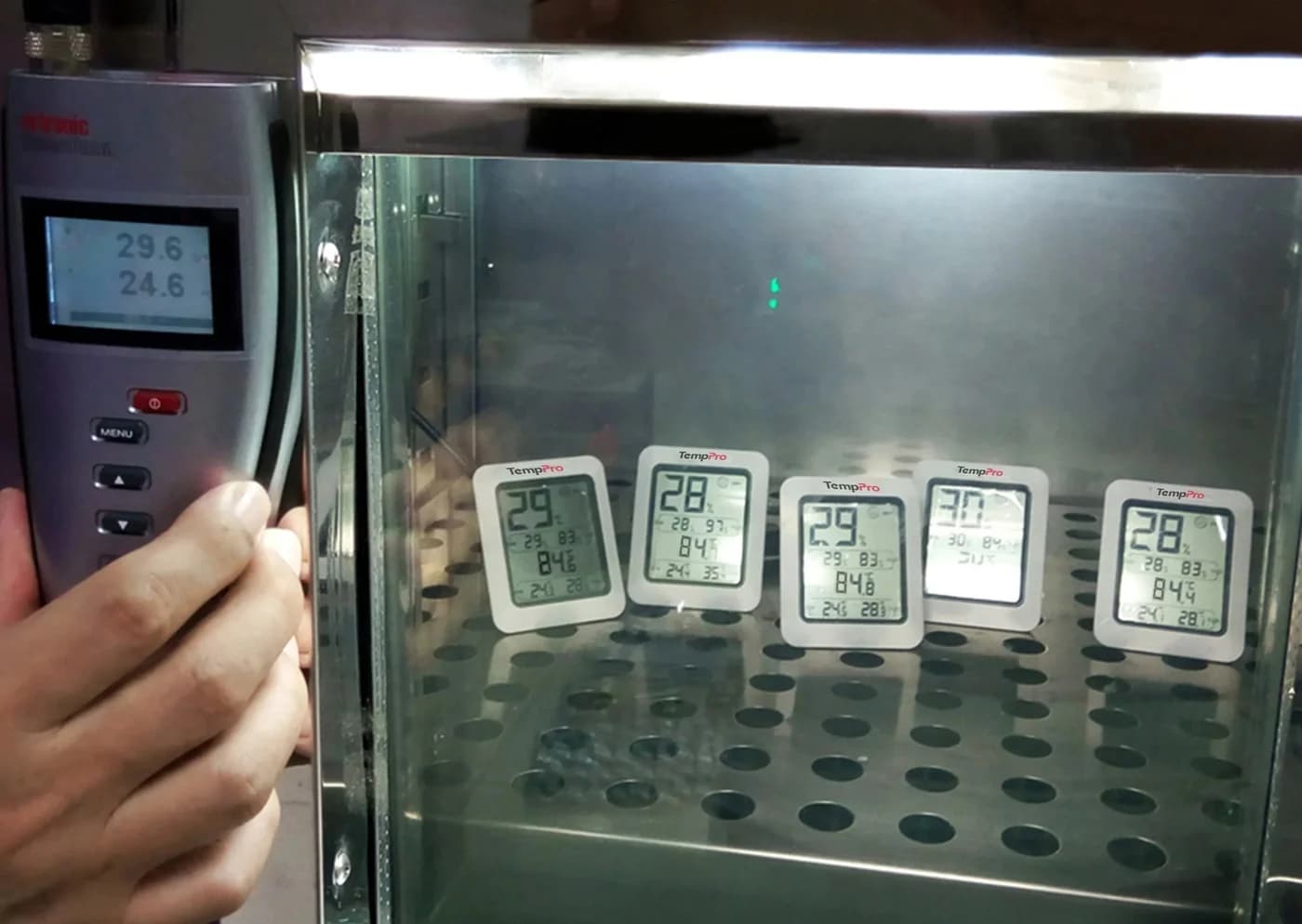
Check conditions before paying for a different technology. The TP50 displays temperature and humidity plus high/low records; its maker states ±1°F temperature accuracy and ±2–3% RH humidity accuracy. Use the records to check the room through colder periods, then follow the numerical readings rather than buying from a room-size claim alone.
TempPro
A basic battery-powered thermo-hygrometer (sold for years as the ThermoPro TP50) with an LCD showing high and low records, a comfort indicator and three ways to place it.
Check package and model options
- Temperature, relative humidity
Choose the single TP50 if you need a monitor for one location; multipacks change quantity. TempPro's title says “backlit,” but its specification table says “Backlight: No”—do not assume the title establishes another version. Maker specifications. Check price on Amazon.
Power, room heat and published noise
Running cost: compare energy per water removed under matching conditions. EPA defines IEF in liters per kilowatt-hour and says higher is more efficient. Rated input alone cannot settle this pair's running cost, especially with the EPD30 power discrepancy. For an electricity budget, convert watts to kilowatts, multiply by running hours, then apply your electricity tariff; cycling changes actual consumption. EIA electricity measurement.
Room heat: Frigidaire explicitly returns warm air, and Ecor Pro heats its regeneration stream. Do not buy either as room cooling. These documents do not provide comparable room-temperature-rise measurements.
Quietness: the sound figures above use different reporting details. Ecor Pro's page conflicts internally between 40 dB copy and a 49 dB table; its separate sheet specifies 49 dB at 3 feet. Frigidaire's sheet does not state distance. Its manual also identifies dripping, rushing air, refrigerant gurgling and compressor chatter. We cannot name a quieter winner from these documents; check the return terms before committing to an occupied-room installation.
Complete kit and placement checklist
The Frigidaire manual requires a level floor and at least 12 inches around the unit; its diagram additionally marks 24″ above. Keep intake and outlet clear. For the EPD30, keep the short exhaust unobstructed and follow the manual's grounded-supply requirement and ban on extension cords.
- Yes: Exact US model and electrical label checked against its manual
- Yes: Frigidaire: accessible bucket, or compatible garden hose and a lower drain without uphill sections
- Yes: EPD30: suitable wet-air duct, termination outdoors or in another well-ventilated area, within the manual's length limit
- Yes: Clear airflow and access to clean the filter
- Partly: Optional remote humidistat for EPD30: confirm the compatible accessory and package contents
- No: A water hose cannot replace the EPD30's wet-air exhaust duct
The EPD30 manual describes an optional 24 V remote humidistat, supplied separately. Do not order it automatically: check whether the built-in control and proposed location meet your needs. Our indoor humidity and hygrometer guide explains how to track the result after installation.
How we choose
This is document-based research, checked November 2, 2026. We read manufacturer manuals, specification sheets and product pages, plus DOE rating guidance and the exact Frigidaire certification record. We have not physically evaluated these appliances. The recommendations prioritize operating limits and feasible moisture removal routes; published capacity and noise are qualified by their conditions. Unresolved maker conflicts stay visible, and an unavailable matching manual keeps the Ivation off our recommended shortlist.
Verdict
Start with FHDD3534Y1 for a heated room and bucket or gravity drainage. Consider EPD30 US for a colder installation with suitable wet-air exhaust, after confirming its current power label. Measure first with a monitor such as the TP50 if room conditions are uncertain. For larger conventional capacity or uphill water drainage, use the best dehumidifiers guide.
Sources
- Frigidaire: FHDD3534Y1 sheet and use and care manual.
- Ecor Pro: US manual, EPD30 sheet and current product page.
- Government sources: EPA buying guidance, DOE testing and capacity, and FHDD3534Y1 record.
- Other official documents: Ivation sell sheet and TempPro specifications linked above; EIA electricity measurement linked under power.
Frequently asked questions
At what temperature should I choose a desiccant dehumidifier?
There is no universal changeover temperature. EPA flags possible compressor-coil frosting below 65°F, but the Frigidaire FHDD3534Y1 manual permits operation from 41°F to 89°F and documents automatic defrost. Below that model's minimum, consider a documented cold-capable desiccant: the US Ecor Pro EPD30 manual allows -4°F to 104°F, but requires moist-air exhaust ducting outside the room.
Is a desiccant dehumidifier quieter than a compressor?
The technology alone does not establish that. Frigidaire publishes 48 dBA on low for the FHDD3534Y1 without a measurement distance. Ecor Pro's EPD30 sheet gives 49 dB at 3 feet, while its product description also says 40 dB. Different measurement details and conflicting copy prevent a fair quietness ranking. Frigidaire also documents airflow, dripping, refrigerant and compressor sounds.
Does a desiccant dehumidifier need a drain hose?
Check the design. The Ecor Pro EPD30 vents moisture as warm wet air and needs an exhaust duct outside the room, rather than a liquid drain hose. Ivation's IVADDH06 sell sheet describes a collection tank and continuous drainage. A compressor model such as the Frigidaire FHDD3534Y1 offers a bucket or gravity drainage, but has no built-in pump for an uphill water route.
Which uses less electricity, compressor or desiccant?
These documents do not establish a universal winner. Frigidaire lists 360 W and an integrated energy factor of 2.01 L/kWh. The EPD30 manual lists 350 W, but its separate specification sheet lists 400 W. Input watts alone do not show water removed per unit of energy, and the cited capacity ratings use different conditions. Confirm the unit's label and compare efficiency on a matching test basis.
Related guides
Comparison · Humidifiers & Dehumidifiers
Levoit Studio Smart vs Vornado EV100: Wicks, Controls and Cleaning
Compare Levoit Studio Smart 450S and Vornado EV100: washable versus replacement wicks, app controls, cleaning tasks, output conditions and published noise data.
Explainer · Humidifiers & Dehumidifiers
Humidifier White Dust: Fix the Water Before Replacing the Machine
Stop humidifier white dust with the right water and model-specific care. Compare refill routines, approved filters and when an evaporative model makes sense.
Comparison · Humidifiers & Dehumidifiers
Vicks V750 vs Levoit LV600S: Steam, Warm Mist and Winter Upkeep
Choose Vicks V750 steam or Levoit LV600S ultrasonic mist with clear advice on white dust, power ratings, refilling, humidity controls and winter upkeep.