

Explainer
True HEPA vs HEPA: What the Label Actually Proves
Decode True HEPA, HEPA-type and H13 claims before you buy. Compare Coway, Levoit and Blueair wording, test conditions and the evidence behind purifier labels.
By thisHUSH EditorialUpdated November 3, 20267 min read2 picks
On this page · Quick picks and claim comparison
About this guide
thisHUSH covers comfort, quiet and air-quality gear, not health. Nothing on this site is medical advice: for sleep, breathing or hearing concerns, talk to a doctor.
True HEPA is not, by itself, a higher whole-purifier performance grade than HEPA. For a current HEPA-labelled mechanical purifier, our starting pick is the Coway Airmega Mighty2 AP-1512N; choose the Levoit Core 300S-P when its small-room rating and app schedules fit your needs. Choose between them using the documented filter claim and delivered-air figures, rather than the extra word on a listing. Coway specifications · Levoit specifications
EPA describes HEPA's familiar baseline as at least 99.97% removal at 0.3 microns. Its technical guide also cautions that consumer HEPA terminology lacks a widely accepted performance definition, so a label needs its supporting documents. EPA definition · EPA technical guide, HEPA section
Official documents reviewed November 2, 2026. These are manufacturer claims and a document comparison, without physical product testing.
Quick picks and claim comparison
- Start with Coway Mighty2 if you want a HEPA-labelled filter in a mechanical purifier. Its Max2 cartridge combines carbon and HEPA.
- Choose Levoit Core 300S-P for VeSync schedules when its 219 sq ft at 4.8 air changes/hour rating suits the room. Its purifier page calls the included cartridge a 3-Stage Original Filter.
- Use the Blueair example below to understand hybrid filtration. The reference is specifically 311i Max; its figures must not be transferred to a 211i Max or another model.
Compare specifications and all conditions
Coway Mighty2 AP-1512N — HEPA-labelled pick
- What its official document says
- Max2: activated carbon + HEPA; product copy claims over 99.97% at 0.3 microns
- Test limitation to retain
- The percentage alone does not establish a named filter-test method
- Published CADR
- 240 smoke, per Coway
Levoit Core 300S-P — app-control pick
- What its official document says
- Included 3-Stage Original Filter
- Test limitation to retain
- Do not transfer the replacement page's Core 300-P Sleep Mode qualification to the 300S-P
- Published CADR
- 141 CFM; pollutant unspecified
Blueair Blue Pure 311i Max — documentation example
- What its official document says
- HEPASilent combines mechanical and electrostatic filtration; claims 99.97% down to 0.1 microns
- Test limitation to retain
- Its percentage footnote describes PM2.5 testing for up to 90 minutes
- Published CADR
- 283 CFM smoke, per Blueair
Full comparison table
Swipe to compare. Row labels stay visible.
| Exact model / role | What its official document says | Test limitation to retain | Published CADR |
|---|---|---|---|
| Coway Mighty2 AP-1512N — HEPA-labelled pick | Max2: activated carbon + HEPA; product copy claims over 99.97% at 0.3 microns | The percentage alone does not establish a named filter-test method | 240 smoke, per Coway |
| Levoit Core 300S-P — app-control pick | Included 3-Stage Original Filter | Do not transfer the replacement page's Core 300-P Sleep Mode qualification to the 300S-P | 141 CFM; pollutant unspecified |
| Blueair Blue Pure 311i Max — documentation example | HEPASilent combines mechanical and electrostatic filtration; claims 99.97% down to 0.1 microns | Its percentage footnote describes PM2.5 testing for up to 90 minutes | 283 CFM smoke, per Blueair |
Scroll horizontally to see every column
| Exact model / role | What its official document says | Test limitation to retain | Published CADR |
|---|---|---|---|
| Coway Mighty2 AP-1512N — HEPA-labelled pick | Max2: activated carbon + HEPA; product copy claims over 99.97% at 0.3 microns | The percentage alone does not establish a named filter-test method | 240 smoke, per Coway |
| Levoit Core 300S-P — app-control pick | Included 3-Stage Original Filter | Do not transfer the replacement page's Core 300-P Sleep Mode qualification to the 300S-P | 141 CFM; pollutant unspecified |
| Blueair Blue Pure 311i Max — documentation example | HEPASilent combines mechanical and electrostatic filtration; claims 99.97% down to 0.1 microns | Its percentage footnote describes PM2.5 testing for up to 90 minutes | 283 CFM smoke, per Blueair |
Sources: Coway, Levoit purifier, Levoit filter, Blueair 311i Max specifications and footnotes. The CADRs are maker-published; exact model entries in the AHAM directory have not been independently confirmed here.
HEPA, True HEPA, HEPA-type and H13: read the actual claim
HEPA describes a particle filter. EPA calls it a pleated mechanical filter and gives the baseline above. 0.3 microns is not a minimum capture size: EPA explains that larger and smaller particles are captured with higher efficiency. A listing that advertises a smaller particle therefore needs more scrutiny than simply comparing the decimal places. EPA
True HEPA should prompt the same document check. Do not assume that “True” identifies a laboratory, certification program or additional performance class. EPA's consumer-terminology caveat is why we ask what was tested, rather than treating the adjective as verification. EPA technical guide
HEPA-type, HEPA-like and HEPA-grade need their own efficiency statement and test basis. Leave the performance unconfirmed when those are missing; do not silently promote descriptive wording into the EPA baseline.
H13 and H14 add a different classification question. Camfil documents an EN 1822 H13 efficiency of 99.95% and explains H14 as 99.995% at the most penetrating particle size, or MPPS. Its factory-testing explanation distinguishes average efficiency from local leaks. These class claims and the EPA's 0.3-micron baseline have different test bases: a smaller-looking percentage is not enough to rank them. Ask for the cited standard and the report for the actual filter. None of the purifier examples here is being assigned an H13 or H14 class. Camfil H13 example · Camfil factory testing
A filter result is not a whole-room result
First identify the test object: a sample of filter media, an assembled filter or the complete purifier. A material-efficiency claim cannot, on its own, establish how the installed filter seals inside the device. Camfil discusses defects in media and seals; EPA also notes that overloaded filters can reduce airflow and increase air bypass. Neither source establishes a leakage rate for these consumer models. Camfil · EPA technical guide
Then check delivery. CADR means clean air delivery rate: AHAM describes it as the volume of filtered air delivered, with separate smoke, dust and pollen scores. EPA explains that delivery depends on removal efficiency and airflow. A high filter percentage alone therefore cannot rank complete purifiers. AHAM · EPA technical guide
- Yes: A filter report supports the efficiency and conditions it actually covers.
- Partly: A complete purifier's CADR adds delivered-air evidence; retain the pollutant label.
- No: A filter percentage does not mean the same percentage of a room's particles disappears immediately.
For room selection, compare an identified CADR with the room it must serve. EPA says published CADR is typically measured at the highest speed and lower settings filter less air. Do not pair a maximum CADR with a minimum noise figure as though they describe one operating mode. Our bedroom purifier guide considers that practical choice. EPA consumer guide
HEPA-labelled mechanical pick: Coway Mighty2 AP-1512N
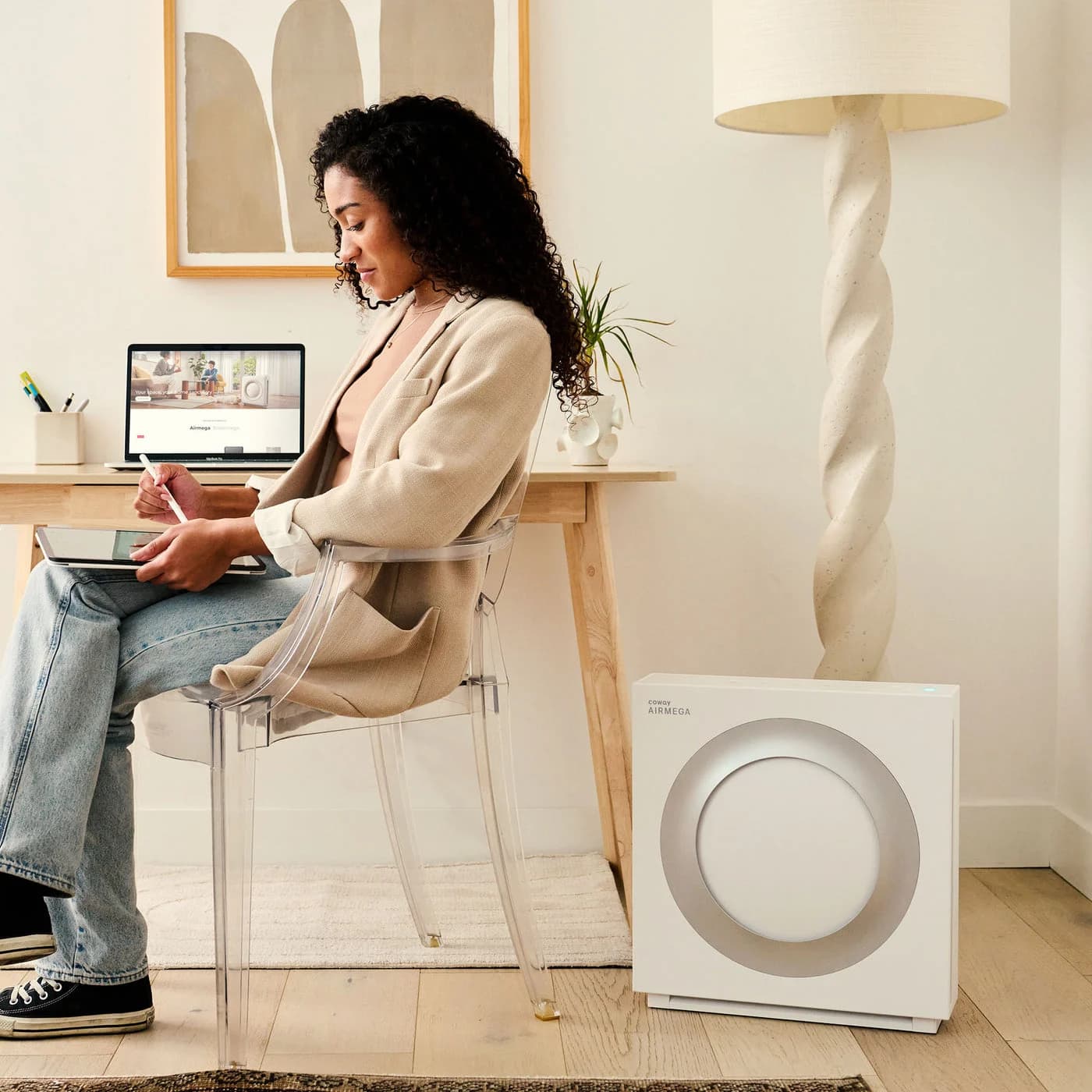
Coway
Coway Airmega Mighty2 AP-1512N
The 2026 successor to Coway's Mighty: smoke CADR 240, a side-access pre-filter plus a combined carbon and HEPA filter, a PM1/2.5/10 laser sensor, and a purely mechanical design with no ionizer.
Check package and model options
- 240 CFM smoke CADR
- Removable pre-filter + Max2 filter (activated carbon + HEPA)
- 19 dB lowest setting
Choose Mighty2 for its washable pre-filter and combined Max2 carbon/HEPA cartridge. Coway publishes smoke CADR 240 and an over 99.97% at 0.3 microns particle claim. CARB lists AP-1512N as Mechanical, a useful distinction if that filtration approach is part of your buying requirement. That listing still does not certify HEPA performance. Coway · CARB directory and program explanation
The documentation limit is the missing bridge between the percentage and a complete filter-test report. Request that report if a particular efficiency class or operating mode is essential to your purchase.
Generation trap: Mighty2 AP-1512N is different from original Mighty AP-1512HH. The original's linked one-sheet calls its filter True HEPA and lists a separate deodorization filter and bipolar device; Mighty2 lists a combined Max2 cartridge. The original sheet also describes a 99.999% at 0.01 microns claim under a modified SPS-KACA 002-132:2018 chamber protocol at maximum fan speed. That is not documentation of the Mighty2 filter's performance. Match the model and filter before borrowing any claim. Original Mighty one-sheet
Small-room app pick: Levoit Core 300S-P
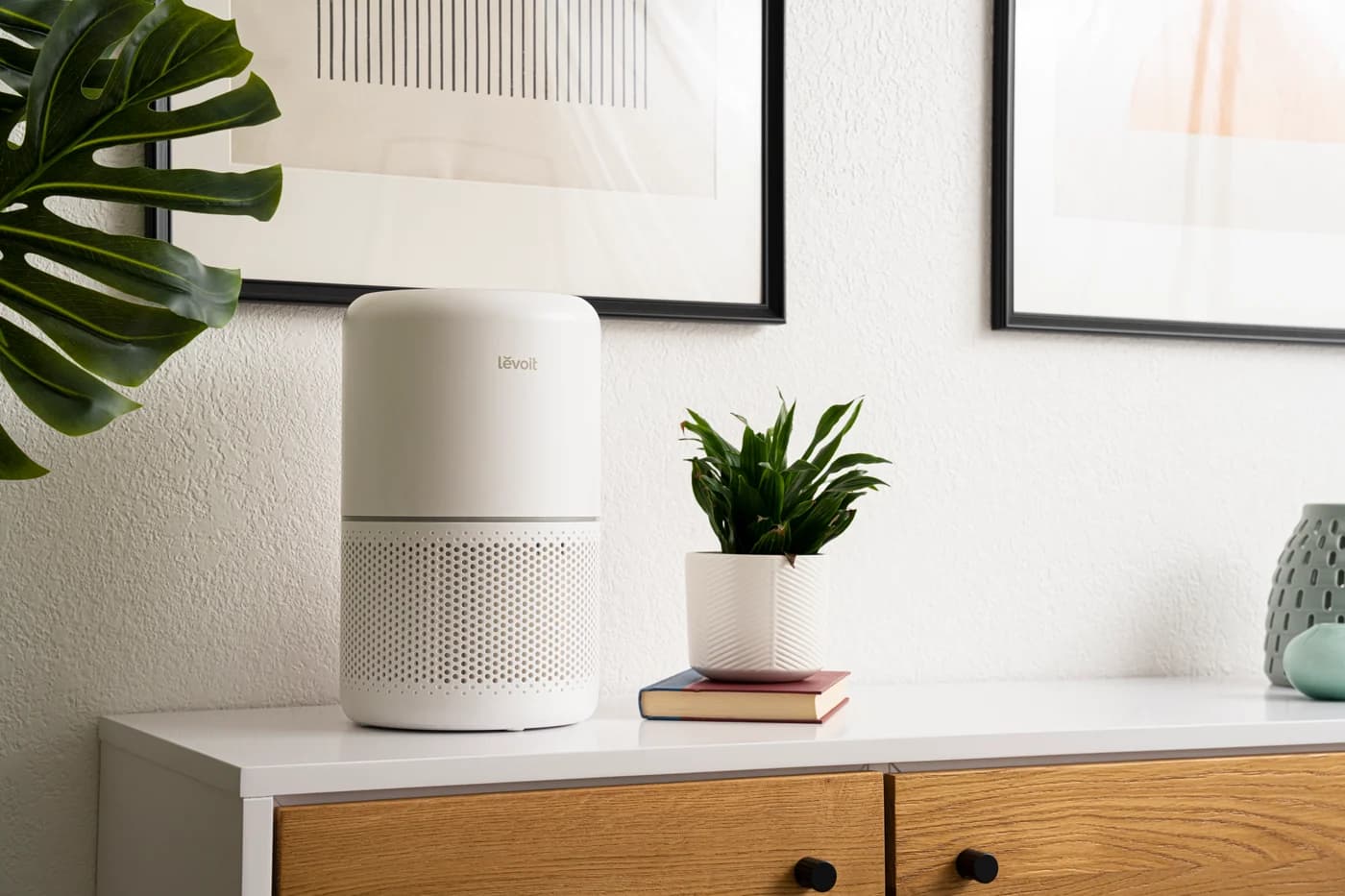
Levoit
A compact Wi-Fi purifier with a 3-stage filter, sleep mode and app or voice control, sized by Levoit at 219 sq ft on the 4.8-air-change basis.
Check package and model options
- 219 sq ft room
- 3-stage filter (Levoit's 'Original' filter; the page does not call it True HEPA)
- 22 dB lowest setting
Choose this for VeSync schedules and app control, with the room rating shown above. Levoit's storefront calls it Core 300S-P, while the specification block says Core 300S. Its published 141 CFM CADR is not labelled smoke, dust or pollen, so we leave that distinction unresolved. Levoit purifier specifications
Filter and mode trap: the Original replacement-filter page claims 99.97% down to 0.3 microns for its main filter. Its separate HEPA-efficiency statement names Core 300-P in Sleep Mode and cites IEST RP C001.7. Do not extend that statement to every speed or automatically to the 300S-P. IEST's own practice summary covers filter units and distinguishes performance levels; the reference alone is not a model-specific report. IEST practice
That filter page also names the 300S-P in its summary but omits it from the shorter compatibility line. The US 300S-P manual identifies the Original cartridge as Core 300-P-RF; match that part and your market. Our Levoit Core model and filter guide also compares the Coway alternatives.
Blueair example: keep HEPASilent's conditions attached
Blueair's 311i Max page describes HEPASilent as mechanical plus electrostatic filtration and claims 99.97% removal down to 0.1 microns. The linked percentage footnote says “Tested on PM 2.5 up to 90 mins.” Our reading: that footnote alone does not establish a minimum efficiency at 0.1 microns directly comparable with EPA's baseline. Request the complete report before making that comparison. Blueair claim and footnotes
Filter-package trap: the standard box includes a Particle & Carbon filter and a pre-filter. Blueair also offers SmokeBlock and AllergenBlock options. Recheck the installed filter and its attached claim when changing the package. Its page also warns that updated CADR and room figures can differ from packaging; retain the document's basis when comparing an older box.
Read the 311i Max specifications at Blueair
Buying checklist: five fields to copy before ordering
Use this as a short request to the maker when the listing leaves something out:
Exact model and filter
Copy the full purifier model, market and installed filter part; note any bundle substitution.
Efficiency and particle size
Keep the percentage beside its particle size or MPPS basis.
Method and report
Ask for the named standard, edition and report identifying that filter or device.
Conditions
Retain the fan mode, test duration and any conditioning described in the claim.
Scope and delivery
Identify media, assembled filter or whole device; separately record the pollutant-labelled CADR.
For independent delivery evidence, search the exact model in the AHAM directory. For CARB, remember the program's electrical-safety and electronic-device ozone requirements: CARB expressly says it does not evaluate pollutant-removal effectiveness. EPA likewise does not certify individual purifier brands. CARB · EPA
Keep particle and gas questions separate, too. EPA says CADR rates particles; gas filtration requires a suitable gas-removal filter, such as activated carbon, with sufficient material. A HEPA percentage cannot settle an odor-removal purchase. EPA consumer guide
How we choose
We compare official product pages, filter listings, manuals and the explanations published by EPA, AHAM, CARB and IEST. Recommendations follow the documented filtration approach and useful controls. We preserve model, mode and compatibility conflicts instead of filling gaps with another product's claims. The Blueair reference deliberately identifies the exact model behind its figures.
For a broader shortlist after completing the document check, see our best air purifiers and research method.
Official documents
- EPA HEPA definition and consumer selection guide.
- AHAM filtration standards and CARB program and directory.
- Coway Mighty2 specifications, Levoit 300S-P specifications and Blueair 311i Max specifications and claim footnotes.
Verdict
Start with Coway Mighty2 for a HEPA-labelled mechanical design, or Levoit Core 300S-P for app schedules when its room rating fits. Use True HEPA as a prompt to request evidence. The buying decision should survive removal of the adjective: exact filter, stated efficiency, named test, retained conditions and suitable whole-device delivery.
Our picks at a glance
- 1
Coway Airmega Mighty2 AP-1512N
Choose for: Mechanical filtration with a washable pre-filter and one combined carbon/HEPA replacement.
Limit: Smoke CADR is maker-rated at 240; the cited specifications do not state units. No AHAM or ENERGY STAR listing was confirmed.
- 2
Choose for: Small-room app pick
Check before buying: Levoit's CADR figure isn't labelled smoke, dust or pollen
Frequently asked questions
Is True HEPA better than HEPA?
The word True alone does not establish a higher performance grade. EPA describes the familiar HEPA baseline as at least 99.97% removal at 0.3 microns, but its technical guide also cautions about consumer HEPA terminology. Ask for the exact filter, test method and conditions. Compare the complete purifier separately using its published CADR.
Can HEPA filters capture particles smaller than 0.3 microns?
Yes. EPA explains that 0.3 microns represents the difficult particle size in its HEPA definition, rather than a lower capture limit; particles larger or smaller are captured with higher efficiency. That does not make every claim about a smaller particle size directly comparable. Check the test method, test object and operating conditions attached to each claim.
Is the Levoit Core 300S-P a True HEPA purifier?
Levoit's current US purifier page describes a 3-Stage Original Filter, without establishing an all-speed True HEPA claim for the Core 300S-P. Its Original replacement-filter page states a main-filter particle-removal percentage, but the separate HEPA-in-Sleep-Mode statement specifically names Core 300-P. Keep those claims scoped to their named filter, model and mode instead of transferring them to the smart model.
Does AHAM or CARB certification prove a filter is HEPA?
Those programs answer different questions. AHAM's CADR describes delivered filtered air with separate smoke, dust and pollen scores. CARB certification addresses electrical safety and, for electronic air cleaners, ozone emissions; CARB expressly says it does not evaluate pollutant-removal effectiveness. Neither label substitutes for the documentation behind a particular HEPA filter claim.
Related guides
Comparison · Air Purifiers
Coway Airmega 250 vs 400: Room Fit, Controls and Filter Costs
Choose the Coway Airmega 250 or 400 by room volume, floor space and filter costs, with clear 250S/400S differences and the exact replacement sets to order.
Comparison · Air Purifiers
Blueair 211i Max vs 311i Max: Room Size, Filters and Which to Buy
Choose the Blueair 211i Max or 311i Max by room size, footprint and controls. Compare current CADR figures, confusing model names and replacement-filter fit.
Comparison · Air Purifiers
Coway Airmega Mighty vs Mighty2: AP-1512HH and AP-1512N Compared
Choose the right Coway Mighty: compare Mighty2 and AP-1512HH airflow, filters, controls and noise, decode similar names, and decide if upgrading makes sense.