

Comparison
AirGradient ONE vs Airthings View Plus
Sensors, Local Data and Room Setup
Compare AirGradient ONE and Airthings View Plus on sensors, local data, cloud history, power and calibration, with clear picks and a complete buying checklist.
By thisHUSH EditorialUpdated November 3, 20268 min read1 pick
On this page · Our picks at a glance
Our picks at a glance
- 1
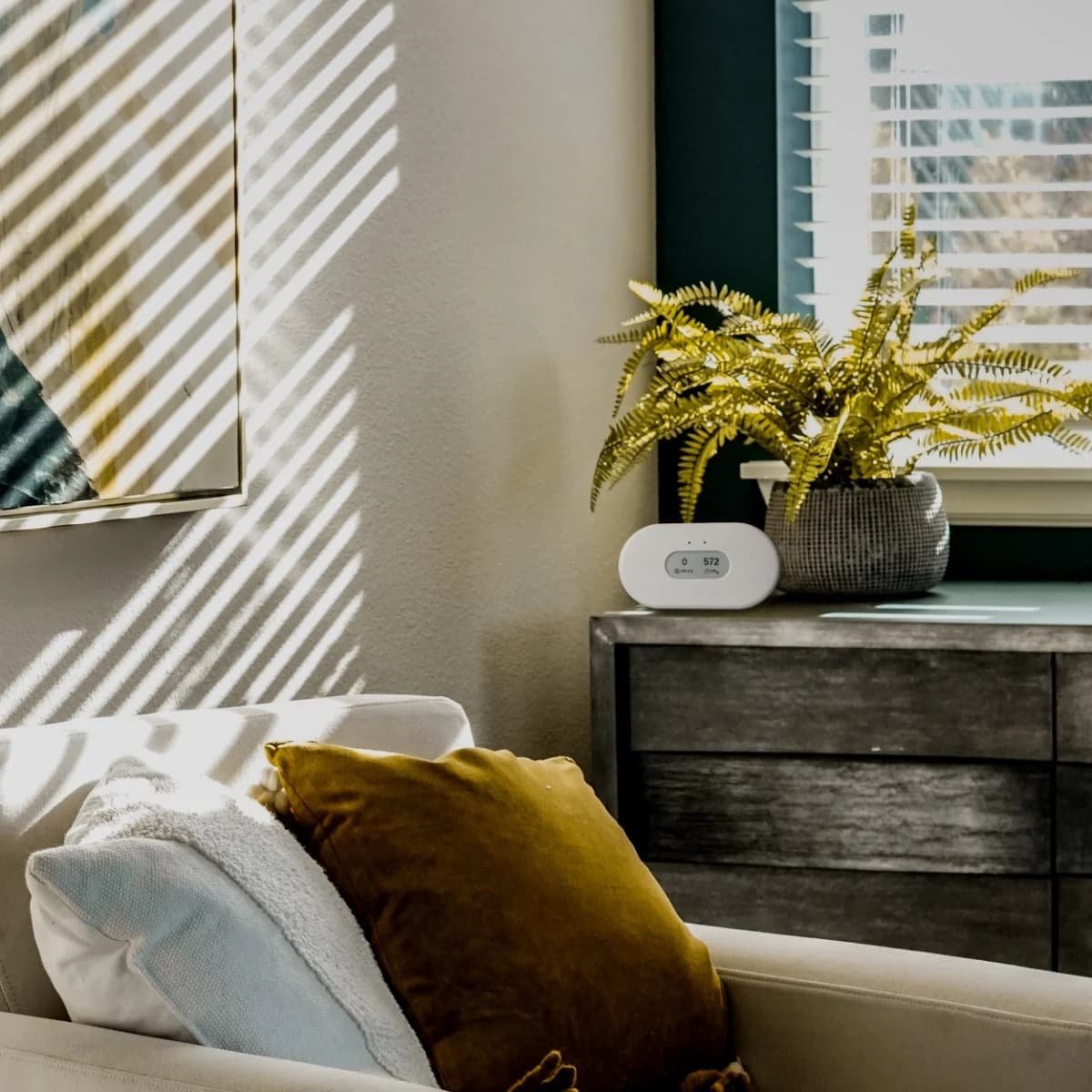
Choose for: Best for radon and battery placement
Check before buying: No Apple HomeKit support
About this guide
thisHUSH covers comfort, quiet and air-quality gear, not health. Nothing on this site is medical advice: for sleep, breathing or hearing concerns, talk to a doctor.
Choose the assembled AirGradient ONE for a fixed room monitor when local Home Assistant data is the priority: it combines NDIR CO2, particles and VOC/NOx indexes without requiring a cloud connection for that integration. Choose Airthings View Plus if you need radon, air pressure, battery placement or its larger e-ink display. Our default for a local monitoring setup is ONE; for a room where radon is part of the brief, it is View Plus.
This compares the fully assembled Wi-Fi ONE I-9PSL with one View Plus, model 2960. Specifications and support documents checked November 2, 2026; recommendations are based on documentation, with no physical test results.
Quick picks and sensor comparison
- Pick ONE for local data: native Home Assistant support and a local API; plan for USB power and a recorder.
- Pick View Plus for radon: radon alongside CO2 and PM2.5, with batteries or USB-C.
Compare specifications and all conditions
CO2
- Assembled AirGradient ONE
- Senseair S8 or S88, NDIR
- Airthings View Plus
- NDIR
PM2.5
- Assembled AirGradient ONE
- Plantower PMS5003, laser scattering
- Airthings View Plus
- Laser-based optical particle counter
Other particle sizes
- Assembled AirGradient ONE
- PM1 and PM10 also measured; maker says PM2.5 has highest accuracy
- Airthings View Plus
- PM2.5 is the specified output
VOC
- Assembled AirGradient ONE
- Sensirion SGP41 VOC index; relative changes
- Airthings View Plus
- Metal-oxide VOC sensor; reported in ppb
NOx
- Assembled AirGradient ONE
- NOx index
- Airthings View Plus
- Not listed
Radon
- Assembled AirGradient ONE
- Not listed
- Airthings View Plus
- Passive diffusion chamber, alpha spectrometry
Air pressure
- Assembled AirGradient ONE
- Not listed
- Airthings View Plus
- Included
Temperature / humidity
- Assembled AirGradient ONE
- Included
- Airthings View Plus
- Included
Screen
- Assembled AirGradient ONE
- 1.3-inch OLED plus LED bar
- Airthings View Plus
- 2.9-inch e-ink; up to four values
Power
- Assembled AirGradient ONE
- USB-C; wall adapter separate
- Airthings View Plus
- Six AA batteries or USB-C
Home Assistant route discussed here
- Assembled AirGradient ONE
- Local integration
- Airthings View Plus
- Cloud integration
Full comparison table
Swipe to compare. Row labels stay visible.
| Measurement or feature | Assembled AirGradient ONE | Airthings View Plus |
|---|---|---|
| CO2 | Senseair S8 or S88, NDIR | NDIR |
| PM2.5 | Plantower PMS5003, laser scattering | Laser-based optical particle counter |
| Other particle sizes | PM1 and PM10 also measured; maker says PM2.5 has highest accuracy | PM2.5 is the specified output |
| VOC | Sensirion SGP41 VOC index; relative changes | Metal-oxide VOC sensor; reported in ppb |
| NOx | NOx index | Not listed |
| Radon | Not listed | Passive diffusion chamber, alpha spectrometry |
| Air pressure | Not listed | Included |
| Temperature / humidity | Included | Included |
| Screen | 1.3-inch OLED plus LED bar | 2.9-inch e-ink; up to four values |
| Power | USB-C; wall adapter separate | Six AA batteries or USB-C |
| Home Assistant route discussed here | Local integration | Cloud integration |
Scroll horizontally to see every column
| Measurement or feature | Assembled AirGradient ONE | Airthings View Plus |
|---|---|---|
| CO2 | Senseair S8 or S88, NDIR | NDIR |
| PM2.5 | Plantower PMS5003, laser scattering | Laser-based optical particle counter |
| Other particle sizes | PM1 and PM10 also measured; maker says PM2.5 has highest accuracy | PM2.5 is the specified output |
| VOC | Sensirion SGP41 VOC index; relative changes | Metal-oxide VOC sensor; reported in ppb |
| NOx | NOx index | Not listed |
| Radon | Not listed | Passive diffusion chamber, alpha spectrometry |
| Air pressure | Not listed | Included |
| Temperature / humidity | Included | Included |
| Screen | 1.3-inch OLED plus LED bar | 2.9-inch e-ink; up to four values |
| Power | USB-C; wall adapter separate | Six AA batteries or USB-C |
| Home Assistant route discussed here | Local integration | Cloud integration |
Table sources: AirGradient product specifications, ONE specification sheet, View Plus product sheet and Home Assistant's Airthings documentation.
Sensor counts hide the buying decision. ONE's NOx index does not substitute for View Plus's radon measurement. Nor should you compare ONE's relative VOC index directly with Airthings' ppb value as if they shared a scale. AirGradient explicitly describes its index as changes rather than absolute concentrations.
- Yes: Need local Home Assistant collection: choose ONE
- Yes: Need radon alongside CO2 and particles: choose View Plus
- Partly: Need comparable VOC numbers across brands: the published outputs use different scales
For alternatives to this pair, use our CO2 monitor shortlist. This page concentrates on the kit and data workflow.
Best for local data: AirGradient ONE
ONE is our pick when you want to collect readings on your own network. AirGradient documents a native Home Assistant integration that works locally; keep the stock firmware current for that route. Its local API instructions also describe direct JSON readings from the monitor on the same Wi-Fi network without a dashboard API token.
Buy assembled deliberately. The assembled version comes with a test report and a twelve-month warranty. The DIY kit shares the hardware but needs assembly and lacks the assembled version's warranty, certifications and test report. Published PM2.5 accuracy also differs: ±4 μg/m³ for assembled versus ±10 μg/m³ for the kit over 0–100 μg/m³. Those are maker specifications, not comparative results from us.
For a bedroom, the LED bar can be switched off. The display controls provide separate day/night screen and LED brightness settings; check the required firmware. The main compromise is power and recording: ONE needs its USB supply, and it has no internal history buffer.
See the assembled ONE at AirGradient
Best for radon and battery placement: Airthings View Plus
View Plus is our pick if radon belongs in the same room dashboard as CO2 and particles. Its e-ink display shows up to four selected values, configured in the app; a wave activates the colored status indicator. The published package includes six AA batteries and a USB cable. If you intend to use USB power, check the wall-adapter provision rather than assuming a cable means a complete mains kit.
Airthings
A seven-sensor home monitor (radon, PM2.5, NDIR CO2, VOCs, temperature, humidity and pressure) with an e-ink display, Wi-Fi, and either battery or USB-C power.
Check package and model options
- Radon, PM2.5, CO2 (NDIR), VOC, temperature, humidity, air pressure
The View Plus page rates battery life at up to two years, depending on router and reporting interval. USB-C enables its hub function for compatible Airthings Wave devices. That hub feature connects other monitors; Home Assistant's documented View Plus route still uses the cloud.
The free iOS/Android app handles setup and trends and requires an account. Its product sheet identifies Bluetooth as the onboarding connection, with Wi-Fi carrying the internet connection.
Local access, cloud history and outages
Local collection: AirGradient's Home Assistant instructions say to tick the setup box disabling data transmission to AirGradient for cloudless use. Choosing a local integration alone is not the same as disabling cloud sending. Keep your own recorder running if you want history.
Cloud collection: ONE's hosted dashboard requires Wi-Fi and registration. Airthings likewise sends readings to its cloud for the app/dashboard. Home Assistant's Airthings integration uses dashboard credentials and API client credentials and is classified Cloud Polling. View Plus can therefore fit Home Assistant, but the documented route differs from ONE's direct local connection.
History and export: both makers document CSV export. Their limits mean different things:
Finest-data limit
- AirGradient dashboard
- Un-bucketed raw, uncalibrated readings: default retention 10 days
- Airthings dashboard
- Export instructions do not specify an equivalent raw-data tier
Longer history
- AirGradient dashboard
- Buckets below one hour: up to 150 days; hourly or larger: currently retained indefinitely
- Airthings dashboard
- Up to one year per CSV export; use adjoining exports for longer periods
Full comparison table
Swipe to compare. Row labels stay visible.
| Export question | AirGradient dashboard | Airthings dashboard |
|---|---|---|
| Finest-data limit | Un-bucketed raw, uncalibrated readings: default retention 10 days | Export instructions do not specify an equivalent raw-data tier |
| Longer history | Buckets below one hour: up to 150 days; hourly or larger: currently retained indefinitely | Up to one year per CSV export; use adjoining exports for longer periods |
Scroll horizontally to see every column
| Export question | AirGradient dashboard | Airthings dashboard |
|---|---|---|
| Finest-data limit | Un-bucketed raw, uncalibrated readings: default retention 10 days | Export instructions do not specify an equivalent raw-data tier |
| Longer history | Buckets below one hour: up to 150 days; hourly or larger: currently retained indefinitely | Up to one year per CSV export; use adjoining exports for longer periods |
These are AirGradient's export/retention rules and Airthings' export instructions. A one-year export window is not a statement that older data is deleted. For ONE, distinguish raw un-bucketed readings from averaged exports that include raw and corrected data.
Outages: AirGradient says ONE cannot save readings during Wi-Fi loss for later upload. Its offline mode still displays readings. Airthings documents approximately two hours of buffering, depending on interval. Neither is our choice for a planned long network outage; ONE's local collection is useful when the internet fails but the local network and recorder remain available.
Power, Wi-Fi and room setup
Both use 2.4 GHz Wi-Fi. ONE's setup guide uses its temporary hotspot and a browser; View Plus uses the phone app. Both makers exclude captive-portal networks from their documented setup, so check an office or guest network before ordering.
Complete the ONE power kit. Its two-meter USB-A-to-USB-C cable is included, but the adapter is not. The power guide specifies 5 V, 2 A and advises against computer USB ports or underpowered hubs. The sales table instead says greater than 2 A; confirm compatibility if reusing an exactly 2 A supply. The unboxing list includes two stands, while the sales page calls stands optional: check the shipped kit.
View Plus power changes particle sampling. Its starter guide specifies PM sampling every 2.5 minutes on USB, every 10 minutes by default on batteries, or every 60 minutes in the battery-saving setting. CO2 samples every five minutes. Hourly cloud updates can therefore make the app look older than the display; a fresh screen reading does not guarantee a fresh upload.
Choose a representative indoor position near breathing height, keep airflow openings clear, and avoid direct sunlight and ventilation outlets, following the ONE setup guidance and View Plus guidance. Airthings advises keeping the monitor stationary during its radon measurement period. For interpreting moisture readings, see indoor humidity and hygrometers.
Choose the position
Follow the maker's placement guidance and keep airflow openings unobstructed.
Choose power and connection
Complete the power kit and verify the room's Wi-Fi before fixing the monitor in place.
Choose where history lives
Set up the cloud account or local recorder, then check that readings actually arrive.
Calibration and specification conflicts
Allow seven days for View Plus's initial CO2 and VOC calibration, according to its calibration guide. For radon, that guide recommends at least 30 days, ideally two months, of continuous measurement. An overnight comparison cannot establish its long-term radon performance.
For CO2, Airthings uses the lowest weekly reading as its fresh-air baseline. AirGradient's sales page/spec sheet say its automatic baseline cycle is seven days, adjustable or disableable; its calibration support guide instead describes an eight-day default. Check the actual firmware setting. AirGradient explains that a persistently occupied, unventilated room can make that baseline assumption understate readings; ask about the calibration configuration for such a room.
Do not select View Plus by its most favorable CO2 accuracy claim. Its own documents differ:
Product page
- Published CO2 accuracy and conditions
- ±50 ppm ±3%; 10–35°C, 0–80% RH, after initial calibration
Help-center specifications
- Published CO2 accuracy and conditions
- ±30 ppm ±3%; 15–35°C, 0–80% RH, after initial calibration
Product sheet
- Published CO2 accuracy and conditions
- ±50 ppm ±5%; specified over 500–2000 ppm, 10–35°C, 0–85% RH
Full comparison table
Swipe to compare. Row labels stay visible.
| Airthings document | Published CO2 accuracy and conditions |
|---|---|
| Product page | ±50 ppm ±3%; 10–35°C, 0–80% RH, after initial calibration |
| Help-center specifications | ±30 ppm ±3%; 15–35°C, 0–80% RH, after initial calibration |
| Product sheet | ±50 ppm ±5%; specified over 500–2000 ppm, 10–35°C, 0–85% RH |
Scroll horizontally to see every column
| Airthings document | Published CO2 accuracy and conditions |
|---|---|
| Product page | ±50 ppm ±3%; 10–35°C, 0–80% RH, after initial calibration |
| Help-center specifications | ±30 ppm ±3%; 15–35°C, 0–80% RH, after initial calibration |
| Product sheet | ±50 ppm ±5%; specified over 500–2000 ppm, 10–35°C, 0–85% RH |
The particle documents disagree too: the product page/PDF give a PM2.5 range of 0–1000 μg/m³, while the help specifications give 0–200 μg/m³ and different error figures. Ask Airthings which document applies to the supplied unit. ONE lists S8 or S88 CO2 modules with different specified accuracy ranges; identify the supplied module before making a numerical comparison. We would choose by sensors and data access, not declare an accuracy winner from these documents.
Buying checklist: assembled unit, single monitor or bundle?
- ONE: order the assembled Wi-Fi version if you want the warranty and test report discussed here. The DIY kit and separate I-9PSL-CE cellular model are different purchase decisions.
- View Plus: check model 2960 and quantity. View Plus Duo means two View Plus monitors; View Plus + Wave Enhance and View Plus + View Radon add different monitors. Do not assume every room in a mixed bundle gets the View Plus sensor set.
- Before a holiday purchase: verify the recipient's network, app/account preference, power adapter and stand provision. Save the exact package description and ask the maker about unresolved cloud or specification terms before paying.
How we choose
We compared manufacturer product pages, specification sheets and support instructions, plus Home Assistant's official integration documentation. Picks prioritize the required measurements, local versus cloud access, useful history and a complete room setup. Published accuracy and battery life are manufacturer claims; this is a documentation comparison. We identify disagreements instead of treating unlike conditions as a ranking. Our editorial method is on How we choose.
Verdict
Buy assembled AirGradient ONE for a fixed, locally recorded setup. Buy View Plus for radon, e-ink and battery placement. Before ordering either, settle where history will live and match the exact kit to your power, network and calibration requirements.
Frequently asked questions
Is AirGradient ONE better than Airthings View Plus?
Choose the assembled Wi-Fi ONE for local Home Assistant monitoring and direct access to readings without the maker's cloud. Choose View Plus for radon, air pressure, an e-ink screen and battery placement. Both include NDIR CO2 and optical particle sensing. Their published accuracy documents do not justify declaring either universally more accurate.
Does AirGradient ONE measure radon?
Radon is not in the ONE's published sensor set. It measures CO2, particles, VOC and NOx indexes, temperature and humidity. View Plus adds radon and pressure, while its published gas measurements do not include a NOx index. Choose the sensor you need rather than comparing the number of advertised measurements.
Does Airthings View Plus work without Wi-Fi?
Its display shows current local measurements, but app and dashboard access depend on readings reaching the Airthings cloud over Wi-Fi. Airthings documents approximately two hours of local buffering during a connection loss, depending on the sampling interval. That is a short interruption buffer, so do not buy it expecting an extended offline data logger.
Do AirGradient ONE or View Plus need a subscription?
Airthings describes its app as free. AirGradient's sales page calls its dashboard subscription-free but also lists twelve months of dashboard and API access; confirm those terms before relying on hosted history. ONE also supports local Home Assistant operation without a cloud connection, which is a separate workflow from either maker's hosted dashboard.
Related guides
Comparison · Air Quality Monitors
TempPro TP50 vs Govee H5075: Display or Bluetooth History?
Choose between the TempPro TP50 and Govee H5075 with clear advice on humidity accuracy, Bluetooth limits, app permissions, CSV export, batteries and pack sizes.
Comparison · Air Quality Monitors
INKBIRD IAM-T1 vs Aranet4 HOME: Logging, Calibration and the Full Kit
Compare INKBIRD IAM-T1 and Aranet4 HOME on CO2 accuracy, logging, calibration and batteries, with an interval worksheet and a complete gift-kit checklist.
Comparison · Air Quality Monitors
Aranet4 HOME vs PRO: Logging, Bluetooth and Which Model to Buy
Choose Aranet4 HOME or PRO with a clear comparison of Bluetooth, logging, export and remote access, plus regional variants and the base station you may need.