

Comparison
AirGradient ONE vs Aranet4 HOME
Desk Monitor or Portable CO2?
Compare AirGradient ONE and Aranet4 HOME for fixed monitoring or portable CO2 readings, with clear advice on sensors, local access, power, logging and exports.
By thisHUSH EditorialUpdated November 3, 20268 min read
On this page · Quick picks and comparison
About this guide
thisHUSH covers comfort, quiet and air-quality gear, not health. Nothing on this site is medical advice: for sleep, breathing or hearing concerns, talk to a doctor.
Choose Aranet4 HOME if you mainly want a CO2 display to carry between rooms: it runs on AA batteries, uses e-ink and stores readings for later phone syncing. Choose AirGradient ONE if you want a powered room monitor with particles and VOC/NOx indexes alongside CO2, especially for local Home Assistant monitoring. Both use dedicated NDIR CO2 sensing; the useful difference is what you measure and where the readings go. (Aranet datasheet, ONE specifications, local integration)
Quick picks and comparison
- Moving a monitor from bedroom to office: buy Aranet4 HOME. Its screen and logging work without a phone connection.
- Leaving a monitor at a desk: choose the assembled Wi-Fi AirGradient ONE for multiple measurements and local network access.
- Keeping history through a network outage: choose Aranet4 HOME, or arrange recording separately for ONE. ONE has no internal history buffer. (Aranet storage, ONE storage)
Compare specifications and all conditions
What does it measure?
- AirGradient ONE, assembled Wi-Fi
- NDIR CO2; PM1, PM2.5, PM10; VOC/NOx indexes; temperature, humidity
- Aranet4 HOME
- NDIR CO2; temperature, humidity, atmospheric pressure
What is on the device?
- AirGradient ONE, assembled Wi-Fi
- 1.3-inch OLED and RGB LED bar
- Aranet4 HOME
- E-ink CO2, temperature and humidity; pressure in app
Power
- AirGradient ONE, assembled Wi-Fi
- USB-C; power adapter separate
- Aranet4 HOME
- Two AA batteries; alkaline pair included
Room-to-room compromise
- AirGradient ONE, assembled Wi-Fi
- Needs USB power wherever placed
- Aranet4 HOME
- 104 g including batteries; no power cable
History on the monitor
- AirGradient ONE, assembled Wi-Fi
- None: send readings to a recorder
- Aranet4 HOME
- 15 days at the default five-minute interval
Local automation path
- AirGradient ONE, assembled Wi-Fi
- Wi-Fi to local API / Home Assistant
- Aranet4 HOME
- Bluetooth to Home Assistant
Missing measurement here
- AirGradient ONE, assembled Wi-Fi
- No radon in the specified sensor set
- Aranet4 HOME
- No particles, VOC/NOx or radon in the specified sensor set
Full comparison table
Swipe to compare. Row labels stay visible.
| Buying question | AirGradient ONE, assembled Wi-Fi | Aranet4 HOME |
|---|---|---|
| What does it measure? | NDIR CO2; PM1, PM2.5, PM10; VOC/NOx indexes; temperature, humidity | NDIR CO2; temperature, humidity, atmospheric pressure |
| What is on the device? | 1.3-inch OLED and RGB LED bar | E-ink CO2, temperature and humidity; pressure in app |
| Power | USB-C; power adapter separate | Two AA batteries; alkaline pair included |
| Room-to-room compromise | Needs USB power wherever placed | 104 g including batteries; no power cable |
| History on the monitor | None: send readings to a recorder | 15 days at the default five-minute interval |
| Local automation path | Wi-Fi to local API / Home Assistant | Bluetooth to Home Assistant |
| Missing measurement here | No radon in the specified sensor set | No particles, VOC/NOx or radon in the specified sensor set |
Scroll horizontally to see every column
| Buying question | AirGradient ONE, assembled Wi-Fi | Aranet4 HOME |
|---|---|---|
| What does it measure? | NDIR CO2; PM1, PM2.5, PM10; VOC/NOx indexes; temperature, humidity | NDIR CO2; temperature, humidity, atmospheric pressure |
| What is on the device? | 1.3-inch OLED and RGB LED bar | E-ink CO2, temperature and humidity; pressure in app |
| Power | USB-C; power adapter separate | Two AA batteries; alkaline pair included |
| Room-to-room compromise | Needs USB power wherever placed | 104 g including batteries; no power cable |
| History on the monitor | None: send readings to a recorder | 15 days at the default five-minute interval |
| Local automation path | Wi-Fi to local API / Home Assistant | Bluetooth to Home Assistant |
| Missing measurement here | No radon in the specified sensor set | No particles, VOC/NOx or radon in the specified sensor set |
Table sources: ONE datasheet, Aranet datasheet, Aranet manual, AirGradient local API, Aranet integration.
For alternatives, start with our best CO2 monitors. If moisture readings are your main task, see indoor humidity and hygrometers.
Best for a fixed room: AirGradient ONE
ONE is our pick for leaving in one room and collecting several kinds of data. The Plantower particle sensor and separate gas sensors add measurements that Aranet4 HOME does not provide. AirGradient describes the VOC and NOx outputs as relative indexes; even the exported VOC ppb value is a relative estimate, not an absolute concentration. Use them to track changes rather than identify an individual chemical. (CSV field definitions)
Plan the power and mounting together. ONE can sit on optional clip-on stands or mount on a wall. The power guide specifies a separate 5 V, 2 A supply and advises against computer USB ports or underpowered hubs. The product table instead says greater than 2 A at 5 V: check the current requirement when choosing an adapter.
The main trade-off is logging. ONE's storage documentation explicitly says readings are not saved locally for later upload when Wi-Fi is down. Buy it for a connected installation, rather than planning to collect an offline room survey and download it afterward.
See AirGradient ONE configurations at the maker
Best for portable CO2 readings: Aranet4 HOME
Aranet4 HOME makes the most sense when the same monitor follows you between rooms. It displays readings independently, and Bluetooth adds phone access. Aranet's FAQ confirms that neither cables nor Wi-Fi are required; the app FAQ says phone access needs Bluetooth, not Wi-Fi or mobile data.
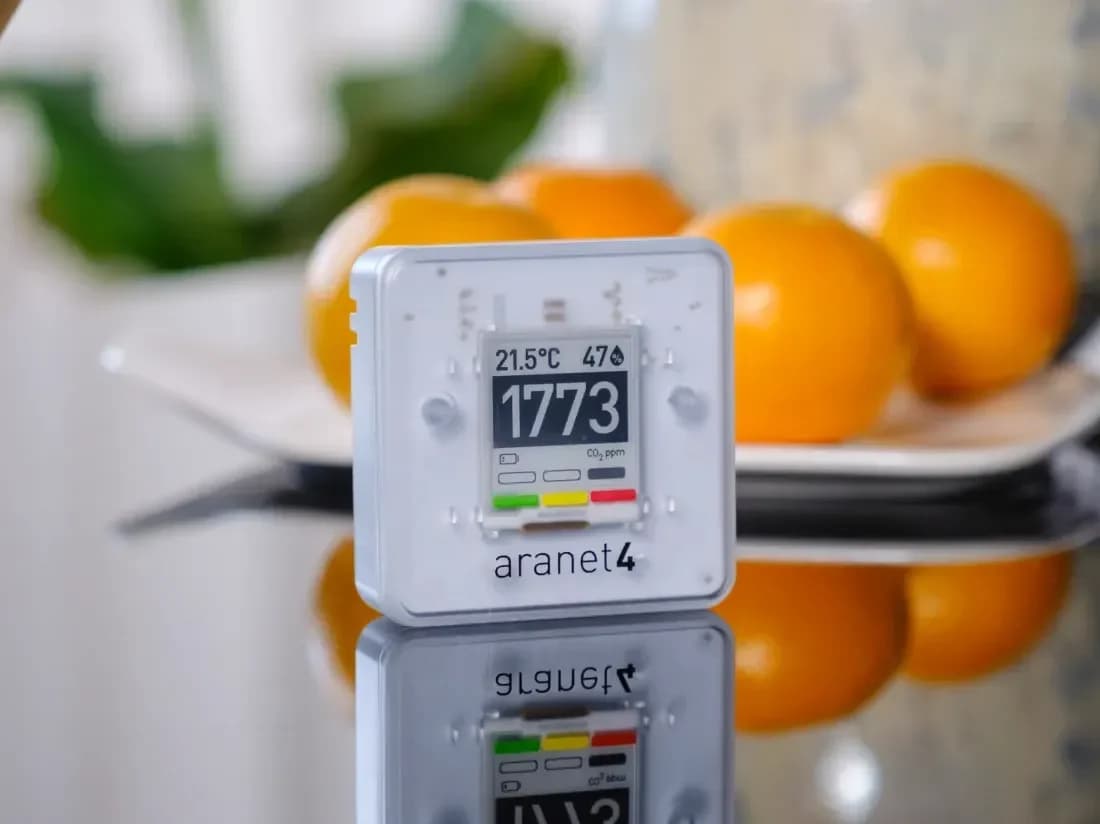
Aranet
A battery-powered, e-ink CO2 monitor with a true NDIR sensor and pressure compensation, plus temperature and humidity, that logs to a phone app over Bluetooth.
Check package and model options
- CO2 (NDIR), temperature, relative humidity, air pressure (pressure shown in the app)
Aranet estimates 2.8 years on alkaline AAs with Bluetooth on, five-minute sampling and a temperature of 20°C. That is an extrapolated estimate, not a runtime guarantee. Switching to one-minute sampling changes the estimate to 0.9 years under those conditions. (Battery table)
Portability does not mean instantaneous readings. The default interval is five minutes, so after moving it, set it down and wait for fresh readings. Aranet advises against breathing directly on it, covering the side vents or placing it beside a window or entrance when seeking a representative room reading. (Manual, placement guidance)
Exact hardware and variants to check
This comparison covers the assembled, display-equipped Wi-Fi ONE, generation 9, and Aranet4 HOME TDSPC0H3. AirGradient's model index calls the mainline ONE I-9PSL-DE; its product page shortens that to I-9PSL. Aranet's current datasheet is version 3.6, dated August 28, 2026; that is a document revision, not a promise of a particular internal hardware revision. (AirGradient model index, product page, Aranet datasheet)
ONE CO2
- What the official documents establish
- SenseAir S8 or S88, both NDIR; the assembly instructions say either may ship
ONE particles
- What the official documents establish
- Plantower PMS5003
ONE temperature / humidity
- What the official documents establish
- Sensirion SHT40, per the specification table; assembly instructions label the module SHT4x
ONE VOC / NOx
- What the official documents establish
- Sensirion SGP41
Aranet4 HOME
- What the official documents establish
- NDIR CO2 with pressure compensation; temperature, humidity and pressure measurements
Full comparison table
Swipe to compare. Row labels stay visible.
| Hardware item | What the official documents establish |
|---|---|
| ONE CO2 | SenseAir S8 or S88, both NDIR; the assembly instructions say either may ship |
| ONE particles | Plantower PMS5003 |
| ONE temperature / humidity | Sensirion SHT40, per the specification table; assembly instructions label the module SHT4x |
| ONE VOC / NOx | Sensirion SGP41 |
| Aranet4 HOME | NDIR CO2 with pressure compensation; temperature, humidity and pressure measurements |
Scroll horizontally to see every column
| Hardware item | What the official documents establish |
|---|---|
| ONE CO2 | SenseAir S8 or S88, both NDIR; the assembly instructions say either may ship |
| ONE particles | Plantower PMS5003 |
| ONE temperature / humidity | Sensirion SHT40, per the specification table; assembly instructions label the module SHT4x |
| ONE VOC / NOx | Sensirion SGP41 |
| Aranet4 HOME | NDIR CO2 with pressure compensation; temperature, humidity and pressure measurements |
Sources: ONE datasheet, generation-9 assembly instructions, Aranet datasheet and sensing explanation.
Assembled versus kit: AirGradient says the kit has the same hardware, but no warranty, certifications or test report. Its published PM2.5 tolerances differ: at 0–100 μg/m³, ±4 μg/m³ for the assembled version versus ±10 μg/m³ for the kit. Those are particle specifications, not CO2 accuracy differences. (Variant specifications)
Other ONE configurations: cellular and displayless versions are separate configurations; the model index lists special versions as closed source. Check the exact model before applying this Wi-Fi comparison. Aranet HOME versus PRO: HOME is the standalone choice here; the manual reserves base-station connectivity for PRO. That system choice is separate from portable versus fixed-room monitoring. (Model index, Aranet manual)
Connection and power map
ONE supports 2.4 GHz Wi-Fi; its setup guide excludes captive portals and WPA Enterprise. Its local API exposes current readings at /measures/current. Aranet4 HOME uses Bluetooth for the phone connection. These are different routes, not interchangeable app features. (ONE Wi-Fi setup, local API, Aranet manual)
ONE, local
USB power → home Wi-Fi network → Home Assistant or your own recorder. AirGradient cloud is optional.
ONE, cloud
USB power → Wi-Fi and internet → AirGradient Dashboard. Register the monitor for dashboard access.
Aranet4 HOME
AA batteries → on-device screen and memory → nearby phone over Bluetooth. Home Assistant needs its own Bluetooth reception.
Sources: ONE local server, dashboard registration, Aranet integration.
For ONE, Home Assistant documents firmware 3.1.1 or later for its legacy local API, discovery over the network and polling every minute. For Aranet, it requires firmware 1.2.0 or later, working Bluetooth and Smart Home integration enabled in the Aranet Home app. Both can therefore serve local automation; ONE suits a fixed network installation, while Aranet must remain within Bluetooth reception. (ONE integration, Aranet integration)
ONE's Offline Mode keeps readings on the display without Wi-Fi. It disables networking, so it is different from keeping local Wi-Fi active while disabling AirGradient cloud communication. (Offline Mode, network controls)
Logging and exporting: what each task needs
Read now without a phone
- AirGradient ONE
- Powered display, including Offline Mode
- Aranet4 HOME
- Battery-powered display
Keep history without a network
- AirGradient ONE
- No onboard storage; arrange a connected recorder
- Aranet4 HOME
- Device memory; sync before it overwrites
Export a spreadsheet
- AirGradient ONE
- Dashboard → Data Export → location, date range and bucket size → CSV
- Aranet4 HOME
- App graph → share → range and format; CSV supported
Avoid losing detail
- AirGradient ONE
- Export before the selected resolution's retention limit
- Aranet4 HOME
- Sync regularly; avoid frequent interval changes
Full comparison table
Swipe to compare. Row labels stay visible.
| Task | AirGradient ONE | Aranet4 HOME |
|---|---|---|
| Read now without a phone | Powered display, including Offline Mode | Battery-powered display |
| Keep history without a network | No onboard storage; arrange a connected recorder | Device memory; sync before it overwrites |
| Export a spreadsheet | Dashboard → Data Export → location, date range and bucket size → CSV | App graph → share → range and format; CSV supported |
| Avoid losing detail | Export before the selected resolution's retention limit | Sync regularly; avoid frequent interval changes |
Scroll horizontally to see every column
| Task | AirGradient ONE | Aranet4 HOME |
|---|---|---|
| Read now without a phone | Powered display, including Offline Mode | Battery-powered display |
| Keep history without a network | No onboard storage; arrange a connected recorder | Device memory; sync before it overwrites |
| Export a spreadsheet | Dashboard → Data Export → location, date range and bucket size → CSV | App graph → share → range and format; CSV supported |
| Avoid losing detail | Export before the selected resolution's retention limit | Sync regularly; avoid frequent interval changes |
Sources: ONE export instructions, ONE storage, Aranet app FAQ, manual and storage guidance.
Aranet has separate device and app limits. Device memory holds 3.5, 7, 15 or 30 days at one-, two-, five- or ten-minute intervals respectively. The manual specifies up to 90 days in the app with CSV export. Sync before removing batteries, which erases device history. Changing intervals can average or pad existing data; it cannot recover finer detail retrospectively. (Datasheet, manual)
ONE's cloud retention depends on export resolution. Un-bucketed raw data defaults to 10 days; five-, ten- and thirty-minute buckets are available for up to 150 days; hourly or coarser data is currently retained indefinitely. Un-bucketed export is uncorrected, while bucketed exports include raw and corrected data. Match the column and averaging interval before comparing graphs. (Export documentation)
Calibration and a fair comparison
Published CO2 accuracy is ±(40 ppm + 3% of reading) for ONE's S8/S88, versus ±(30 ppm + 3%) for Aranet4 HOME. At 1,000 ppm, the calculated tolerances (in ppm) are ±70 for ONE and ±60 for Aranet4 HOME. This is a specification comparison, not a measured head-to-head result.
The conditions matter: ONE specifies 5–30°C and accuracy bands of 400–2,000 ppm for S8 or 400–3,000 ppm for S88. Its S8 humidity condition conflicts: 20–70 percent relative humidity in the PDF, compared with the product page's 0–85% RH. Aranet specifies its quoted tolerance over 0–5,000 ppm, 15–35°C and 0–80% RH. More sensors do not resolve these differences. (ONE datasheet, product specification, Aranet datasheet)
Automatic baseline calibration assumes exposure to fresh air. AirGradient's product page says seven days; its calibration guide describes an eight-day default and warns that a room that never reaches outdoor levels can shift readings downward. Check the configured duration rather than assuming either default. Aranet ships factory-calibrated with manual mode the default; automatic mode requires approximately eight hours of fresh air around 420 ppm each month. (ONE calibration guide, product page, Aranet manual)
Choose a representative position
Set the monitor down away from your breath, direct sun and immediate window or door airflow. Keep vents clear.
Wait for fresh readings
Note the room change and compare settled readings, rather than the number displayed while carrying the monitor.
Match the data
Keep sampling and export averaging consistent; check calibration settings before judging an offset between devices.
Placement follows Aranet's guidance; the comparison procedure is our advice based on the documented sampling, export and calibration behavior.
For manual calibration, use the instructions for your actual unit. Aranet's newer datasheet describes a physical calibration button that may be absent on some hardware; the older manual describes switch toggling. Both support app calibration, which avoids assuming the rear controls match. (Datasheet, manual)
How we choose
These recommendations come from manufacturer specifications, manuals and support documents, plus Home Assistant's own integration requirements. We have not physically tested these monitors. We prioritize the measurement task, power, connection path and recoverable history; published tolerances are not proof of comparative real-world accuracy. Official documents checked November 2, 2026. See how we choose.
Verdict
Buy Aranet4 HOME for a portable CO2 display with onboard logging and Bluetooth exports. Buy the assembled Wi-Fi AirGradient ONE for a fixed room where you want particle and gas indexes alongside CO2, with local network recording or the dashboard. Decide where history will be stored before deciding how many sensors you need.
Frequently asked questions
Does AirGradient ONE work without the internet?
Yes, but distinguish local networking from Offline Mode. ONE can send current readings over your local network to Home Assistant without using AirGradient's cloud. Offline Mode disables networking and keeps readings on the screen. ONE has no internal history storage, so use a connected recorder if you want a record of those readings; it cannot upload missed history afterward.
Does Aranet4 HOME work with Home Assistant?
Yes. Home Assistant's official Aranet integration requires working Bluetooth, Aranet firmware 1.2.0 or later, and Smart Home integration enabled in the Aranet Home app. Keep the monitor within Bluetooth reception of Home Assistant. This makes HOME usable for local automation, although carrying it away from the receiver can interrupt live updates.
Does AirGradient ONE measure radon or replace Aranet4's CO2 sensor with VOC estimates?
Neither model's listed sensor set includes radon. ONE has a dedicated SenseAir NDIR CO2 sensor alongside separate particle and VOC/NOx sensors; its CO2 reading is not calculated from its VOC index. Aranet4 HOME also uses NDIR CO2 sensing. Choose ONE for the additional measurements, rather than assuming its longer sensor list makes its CO2 reading more accurate.
Related guides
Comparison · Air Quality Monitors
Airthings View Plus vs Wave Plus: Sensors, Display and Wi-Fi
Compare Airthings View Plus vs Wave Plus on sensors, display, batteries and remote access, with clear picks and a connection map for a setup across two rooms.
Comparison · Air Quality Monitors
Airthings Corentium Home 2 vs View Radon: Display, Wi-Fi and Saved Data
Choose Home 2 for standalone readings or View Radon for direct Wi-Fi. Compare displays, saved history, exports, hub requirements and exact model differences.
Buying guide · Air Quality Monitors
PM2.5 Monitors: Room Sensor Picks, Placement and Data Logging
Choose a PM2.5 monitor for a room: compare Airthings View Plus and AirGradient ONE, understand sensor limits, and plan placement, offline use and data exports.