

Explainer
What Is CADR? Size an Air Purifier Without the Marketing Math
Understand smoke, dust and pollen CADR, convert CFM to cubic metres per hour, and use ceiling height and air changes to choose a purifier that fits your room.
By thisHUSH EditorialUpdated November 3, 20268 min read3 picks
On this page · Quick picks: compare the same rating
About this guide
thisHUSH covers comfort, quiet and air-quality gear, not health. Nothing on this site is medical advice: for sleep, breathing or hearing concerns, talk to a doctor.
CADR means clean air delivery rate: the volume of particle-filtered air a purifier delivers per unit of time, expressed in cubic feet per minute (CFM) or cubic metres per hour (m³/h). It combines airflow and particle-removal efficiency, so a fan's airflow figure alone does not tell you the CADR. For a mid-size room, start with the Coway Airmega Mighty2, then use the worksheet below to check the fit; the Blueair Blue Pure 211i Max offers more output, while the Levoit Core 300S-P is the compact smart option.
Quick picks: compare the same rating
These are room-sizing examples, selected from published specifications. All CADRs below are the makers' figures, checked November 2, 2026; low-speed output is not established.
Compare specifications and all conditions
Coway Airmega Mighty2 AP-1512N
- Maker CADR: smoke / dust / pollen, CFM
- 240 / 242 / 249
- Room-size basis
- About 372 sq ft, calculated with AHAM's room-size multiplier
- Choose it when…
- You need the middle output tier and want the current Mighty generation
Blueair Blue Pure 211i Max
- Maker CADR: smoke / dust / pollen, CFM
- 435 / 452 / 450
- Room-size basis
- Maker: 674 sq ft at 4.8 air changes per hour
- Choose it when…
- Your room needs more delivery than the Mighty2 provides
Levoit Core 300S-P
- Maker CADR: smoke / dust / pollen, CFM
- 141, pollutant unspecified; no separate figures on the maker page
- Room-size basis
- Maker: 219 sq ft at 4.8 air changes per hour
- Choose it when…
- A small room and app schedules matter most
Full comparison table
Swipe to compare. Row labels stay visible.
| Model | Maker CADR: smoke / dust / pollen, CFM | Room-size basis | Choose it when… |
|---|---|---|---|
| Coway Airmega Mighty2 AP-1512N | 240 / 242 / 249 | About 372 sq ft, calculated with AHAM's room-size multiplier | You need the middle output tier and want the current Mighty generation |
| Blueair Blue Pure 211i Max | 435 / 452 / 450 | Maker: 674 sq ft at 4.8 air changes per hour | Your room needs more delivery than the Mighty2 provides |
| Levoit Core 300S-P | 141, pollutant unspecified; no separate figures on the maker page | Maker: 219 sq ft at 4.8 air changes per hour | A small room and app schedules matter most |
Scroll horizontally to see every column
| Model | Maker CADR: smoke / dust / pollen, CFM | Room-size basis | Choose it when… |
|---|---|---|---|
| Coway Airmega Mighty2 AP-1512N | 240 / 242 / 249 | About 372 sq ft, calculated with AHAM's room-size multiplier | You need the middle output tier and want the current Mighty generation |
| Blueair Blue Pure 211i Max | 435 / 452 / 450 | Maker: 674 sq ft at 4.8 air changes per hour | Your room needs more delivery than the Mighty2 provides |
| Levoit Core 300S-P | 141, pollutant unspecified; no separate figures on the maker page | Maker: 219 sq ft at 4.8 air changes per hour | A small room and app schedules matter most |
The Mighty2 estimate uses smoke CADR × 1.55, AHAM's suggested-room-size rule for an eight-foot ceiling. AHAM describes its comparison basis as 4.8 equivalent air changes per hour (eACH). The Levoit figure remains unspecified in this table; do not silently turn it into a smoke rating. Sources: AHAM's derivation, pages 9–10, Coway, Blueair, Levoit.
Smoke, dust and pollen are separate entries
The AHAM seal lists separate tobacco-smoke, dust and pollen CADRs. EPA explains that these represent small, medium and large particles, respectively. Compare smoke with smoke when sizing from AHAM's rule; compare dust with dust when examining dust delivery. Taking one model's largest number and another's smoke number makes an uneven comparison. The particles and their purpose are explained in EPA's buying guide, page 6.
Higher comparable CADR means faster particle removal. It does not establish odor or gas capacity: EPA's particle CADR system does not rate gases. Activated carbon is a separate consideration, including how much material the filter contains. A product name containing “Smoke” does not make its particle rating an odor rating.
Buying guide: a reusable room-sizing worksheet
Write down length, width, ceiling height, CADR units, pollutant and operating speed. EPA says to count the entire area a purifier would serve in an open floor plan. For this worksheet, assume one rectangular room, reasonably mixed air and a constant operating setting. The calculation estimates equivalent filtered-air delivery; it does not promise uniform particle concentrations throughout a furnished room.
Using AHAM's volume formula, page 9:
- Required CADR in CFM = floor area in sq ft × ceiling height in feet × target eACH ÷ 60.
- Delivered eACH = CADR in CFM × 60 ÷ room volume in cubic feet.
- For metric inputs: required CADR in m³/h = floor area in m² × ceiling height in metres × target eACH. No minute-to-hour conversion is needed here.
For comparing purchases, use the 4.8 eACH basis above, then consider whether your intended use calls for a different target. This is the purifier's contribution, not a measurement of outdoor ventilation. A recirculating purifier does not supply replacement outdoor air.
Worked example: a taller room changes the shortlist
Assume a room 15 feet long, 20 feet wide and 10 feet high. Its floor area is 300 sq ft. At 4.8 eACH, the calculation is 15 × 20 × 10 × 4.8 ÷ 60 = 240 CFM. These dimensions are illustrative inputs; the required output is our calculation from AHAM's formula.
For context, EPA's estimating table gives 195 CFM for 300 sq ft with an eight-foot ceiling. That table is rounded guidance, not an exact substitute for the volume calculation. Using its floor-area figure without accounting for our taller ceiling would understate the requirement.
Against the calculated requirement, Levoit's unspecified 141 CFM is insufficient even before resolving its pollutant label. Coway's 240 CFM smoke figure meets the target at the rated setting, with no spare delivery. Blueair's 435 CFM smoke figure exceeds it. That is a useful shortlist; it still does not prove any model meets the target on low.
Measure the served space
Record length, width and ceiling height; include the connected area in an open plan.
Calculate required delivery
Choose an eACH target and use the formula for your measurement units.
Match the rating
Record the pollutant, CADR unit and exact model rather than just the advertised room area.
Check the intended speed
Ask for output and noise at the setting you will actually run.
CFM versus cubic metres per hour
For a unit conversion, CFM × approximately 1.699 = m³/h; divide by that factor to go back. The conversion factor is documented by purifier maker Oransi. Levoit provides a useful cross-check: it publishes the Core 300S-P at 141 CFM / 240 m³/h, rounded. Those are the same delivery expressed in different units, not competing performance ratings. Convert units before comparing, and retain the pollutant label.
- 4.8 eACHAHAM's room-size comparison basis
- × 1.55Smoke CFM to suggested sq ft, with an eight-foot ceiling
- × 1.699Approximate conversion from CFM to m³/h
Why one purifier advertises several room sizes
Coway's original Mighty AP-1512HH page gives the same purifier 361 sq ft at 4.8 air changes per hour, 874 sq ft at 2, and 1,748 sq ft at 1. The machine has not gained output as the advertised area grows; the assumed turnover has fallen. The newer Mighty2 page's 1,800 sq ft headline likewise uses 1 air change per hour.
Blueair's specification table lists 674 sq ft at 4.8 ACH, but its FAQ says “4 times every 12.5 minutes.” Those statements conflict. Use the explicitly labelled specification table here; the FAQ sentence should not be used as a calculation input. Blueair also says its CADR and coverage figures changed to meet new DOE standards and packaging may differ. Keep the dated source beside the numbers rather than mixing old packaging with current web specifications.
CADR versus HEPA and “True HEPA”
EPA defines HEPA as filter media that can theoretically remove at least 99.97% of particles at 0.3 microns. That efficiency describes a filter; CADR describes delivered particle-filtered air. A filter-efficiency percentage alone cannot tell you how quickly the device processes your room.
For “True HEPA vs HEPA,” look for the actual filter specification. Ask what efficiency, particle size and test method the exact filter meets. Do not promote “HEPA-type” or “HEPA-grade” wording to the EPA definition without supporting evidence. Levoit's cited page calls the included filter three-stage Original; it does not establish a True HEPA specification for that filter. Blueair describes HEPASilent as combined mechanical and electrostatic filtration. Compare their documented CADRs separately from those filter names.
Maximum CADR does not establish bedroom performance
EPA says CADR is typically measured at the highest speed and that lower settings filter less air. Blueair publishes 23–53 dB; Coway gives Mighty2 19–50 decibels; Levoit gives Core 300S-P 22–50 dB. None of those ranges supplies a CADR for each speed. Pairing the lowest noise figure with maximum CADR would invent an operating point.
For a bedroom, ask for same-setting CADR and noise. Buying more maximum output creates potential headroom, but these sources do not quantify how much remains in a quieter mode. Use our bedroom purifier guide for controls and noise considerations.
Coway Airmega Mighty2: start here for a mid-size room
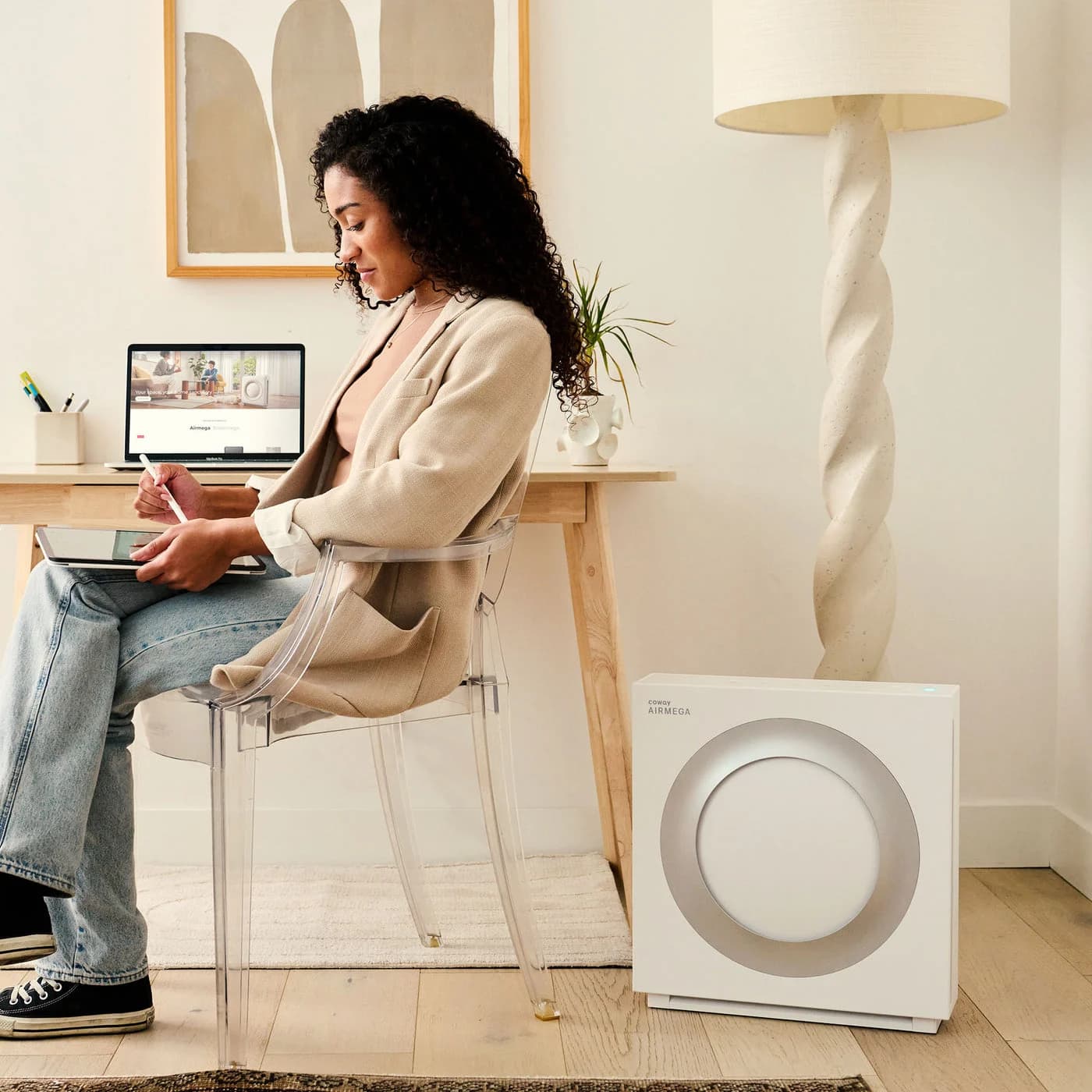
The AP-1512N has maker-rated 240 CFM smoke CADR, a washable pre-filter and combined carbon/HEPA Max2 filter. Its current page identifies it as the evolution of the original Mighty. Choose it when the worksheet fits; distinguish Mighty2 AP-1512N from original Mighty AP-1512HH, whose room figures above are a separate example. They use different filter arrangements. Official specifications.
Coway
Coway Airmega Mighty2 AP-1512N
The 2026 successor to Coway's Mighty: smoke CADR 240, a side-access pre-filter plus a combined carbon and HEPA filter, a PM1/2.5/10 laser sensor, and a purely mechanical design with no ionizer.
Check package and model options
- 240 CFM smoke CADR
- Removable pre-filter + Max2 filter (activated carbon + HEPA)
- 19 dB lowest setting
Blueair Blue Pure 211i Max: larger-room output
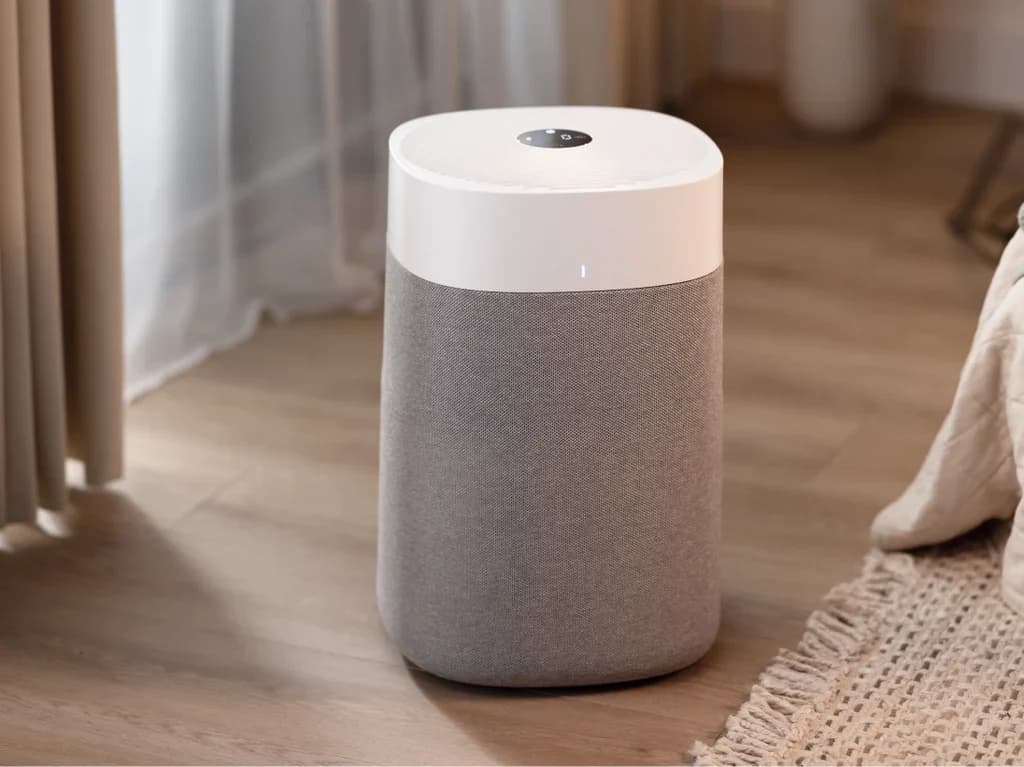
Its maker-rated 435 CFM smoke CADR is the largest labelled smoke figure in this shortlist. Check the full 211i Max name and the included filter: Blueair lists a Particle & Carbon filter in the standard box and offers SmokeBlock and AllergenBlock options. Do not assume a different filter package retains the standard configuration's CADR without matching documentation. Official specifications and contents.
Blueair
A large-room purifier with a 360-degree intake, a washable fabric pre-filter, PM1/PM2.5/PM10 sensing and app control, rated by Blueair at smoke CADR 435 and 674 sq ft.
Check package and model options
- 435 CFM smoke CADR
- 674 sq ft room
- Washable fabric pre-filter + particle and carbon filter (HEPASilent: mechanical plus electrostatic)
- 23 dB lowest setting
Levoit Core 300S-P: compact rooms with schedules
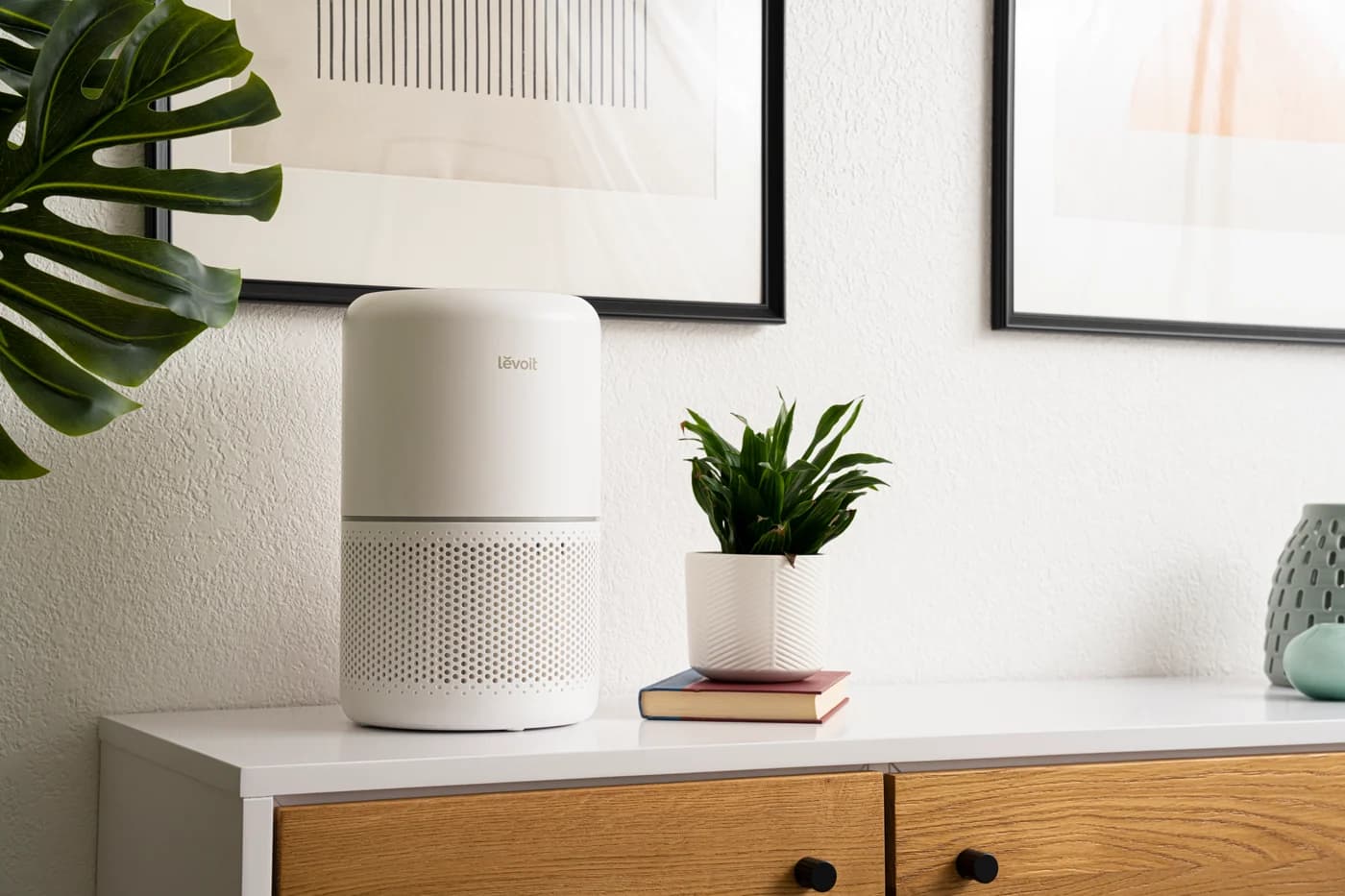
Choose it for a small room when VeSync schedules matter. Levoit calls the purifier Core 300S-P, while its specification block says Core 300S. Match both the product name and model label; use the Core 300 variants guide before switching listings. The included Original filter is already installed. Retain the maker's 141 CFM as unspecified unless a matching certification entry identifies the pollutant. Official specifications.
Levoit
A compact Wi-Fi purifier with a 3-stage filter, sleep mode and app or voice control, sized by Levoit at 219 sq ft on the 4.8-air-change basis.
Check package and model options
- 219 sq ft room
- 3-stage filter (Levoit's 'Original' filter; the page does not call it True HEPA)
- 22 dB lowest setting
How we choose
This is a specification-based explainer, with calculations labelled separately from manufacturer claims. We researched official product pages, EPA guidance and AHAM's current white paper; the worked dimensions are assumptions, not room measurements. We reused the site's existing product records and owner-confirmed purchase identifiers.
AHAM says its directory contains independently verified models and is continuously updated. Its live directory did not expose individual entries through our text fetch on November 2, 2026. Consequently, this page does not present the table as a fresh certification check. Before relying on certification, match the exact model and region in the directory or its AHAM seal. See How we choose.
Verdict
Record the pollutant and units, calculate from the room's volume, then check the intended speed. Mighty2 is the middle-output starting point, 211i Max the larger-room option, and Core 300S-P the compact smart choice. Continue to best air purifiers by room size for the broader buying decision; keep this worksheet alongside it so a bigger coverage headline does not decide the purchase.
Sources
Official sources checked November 2, 2026. Calculations use the stated assumptions; noise ranges and product performance remain manufacturer claims.
- AHAM: directory guidance, ACH FAQ and January 2026 white paper, especially pages 9–12.
- EPA: Guide to Air Cleaners in the Home and HEPA definition.
- Makers: Mighty2, original Mighty, 211i Max, Core 300S-P and Oransi's unit conversion.
Our picks at a glance
- 1
Coway Airmega Mighty2 AP-1512N
Choose for: Mechanical filtration with a washable pre-filter and one combined carbon/HEPA replacement.
Limit: Smoke CADR is maker-rated at 240; the cited specifications do not state units. No AHAM or ENERGY STAR listing was confirmed.
- 2
Choose for: A larger-room purifier with automatic controls and app schedules.
Limit: HEPASilent includes an electronic filtration stage; choose a mechanical-only purifier if you want to avoid that stage.
- 3
Choose for: Automatic controls and app schedules for a smaller room.
Limit: Its 219 sq ft claim uses 4.8 air changes per hour; the headline 1,051 sq ft uses just one. Match the room-size basis.
Frequently asked questions
What is a good CADR for an air purifier?
A good CADR fits the room and the speed you will use. EPA's estimating table pairs a 300-square-foot room with at least 195 CFM, assuming an eight-foot ceiling. Taller ceilings need more output. Compare the same pollutant and units, then check the air-change basis. A maximum-speed CADR does not establish what the purifier delivers in a quieter mode.
Is CADR the same as CFM or airflow?
CFM means cubic feet per minute: a unit that can describe either airflow or CADR. CADR accounts for both airflow and particle-removal efficiency, so an airflow-only figure is not interchangeable with clean-air delivery. CADR can also be expressed in cubic metres per hour. Multiply CFM by approximately 1.699 to convert; check that the two numbers describe the same pollutant and operating setting.
Does True HEPA mean a higher CADR?
The filter label alone cannot establish a purifier's CADR. EPA describes HEPA media as theoretically removing at least 99.97% of particles at 0.3 microns, while CADR concerns the delivery of filtered air by the device. Check the exact model's filter specification and its CADR separately. Do not upgrade HEPA-type or unspecified three-stage wording to a verified HEPA claim.
Does smoke CADR tell me how well a purifier removes odors?
Smoke CADR rates particle removal, not gas or odor capacity. EPA distinguishes particle filters from activated carbon or other media designed for gases and notes that substantial carbon material matters. Use smoke CADR to size particle delivery. For odors, look separately for the exact filter supplied and documented gas-removal performance; a carbon layer does not give the smoke CADR a second meaning.
Related guides
Best picks · Air Purifiers
Best Air Purifiers for Smoke: Wildfire Sizing and Filter Checks
Choose an air purifier for wildfire smoke by confirmed smoke CADR, room size and filtration type, with exact filter checks and EPA's DIY alternative explained.
Explainer · Air Purifiers
Do Air Purifiers Work? Particles, Odours and What to Check
Find out when an air purifier is worth buying: what it does for dust, smoke and odours, what HEPA and CADR prove, and which model fits your room and problem.
Best picks · Air Purifiers
Best Air Purifiers for Dust: CADR, Room Size and Filter Upkeep
Choose an air purifier for airborne dust with separate dust and smoke CADR, clear room sizing, accessible pre-filters and exact replacement parts for each pick.