

Explainer
Do Air Purifiers Work? Particles, Odours and What to Check
Find out when an air purifier is worth buying: what it does for dust, smoke and odours, what HEPA and CADR prove, and which model fits your room and problem.
By thisHUSH EditorialUpdated November 3, 20268 min read3 picks
On this page · Quick picks: buy only for the problem you have
About this guide
thisHUSH covers comfort, quiet and air-quality gear, not health. Nothing on this site is medical advice: for sleep, breathing or hearing concerns, talk to a doctor.
Yes—air purifiers can reduce airborne particles, including dust, pollen and smoke, when their clean air delivery rate suits the room and you run them long enough. They do not clean settled debris or solve damp, and gaseous odours need suitable gas-filter media. Our starting pick is the Coway Airmega Mighty2 AP-1512N; choose the Blueair Blue Pure 211i Max for higher airflow or Levoit Core 300S-P for small-room app schedules. EPA guidance
Quick picks: buy only for the problem you have
These are specification-based choices for particles. Room claims below retain each maker's air-change assumptions.
Compare specifications and all conditions
Coway Airmega Mighty2 AP-1512N
- Choose it for
- A washable pre-filter and combined replacement filter
- CADR, as published
- Smoke 240; dust 242; pollen 249
- Maker's room claim
- 1,800 sq ft at 1 air change/hour
All specifications
- Filter approach
- Pre-filter + Max2 activated carbon and HEPA
Blueair Blue Pure 211i Max
- Choose it for
- Higher airflow for a larger space
- CADR, as published
- Smoke 435; dust 452; pollen 450 CFM
- Maker's room claim
- 674 sq ft at 4.8 air changes/hour
All specifications
- Filter approach
- Particle & Carbon; HEPASilent combines mechanical and electrostatic filtration
Levoit Core 300S-P
- Choose it for
- Small room, VeSync schedules
- CADR, as published
- 141 CFM; pollutant not specified
- Maker's room claim
- 219 sq ft at 4.8 air changes/hour
All specifications
- Filter approach
- Pre-installed 3-stage Original filter
Full comparison table
Swipe to compare. Row labels stay visible.
| Pick | Choose it for | CADR, as published | Maker's room claim | Filter approach |
|---|---|---|---|---|
| Coway Airmega Mighty2 AP-1512N | A washable pre-filter and combined replacement filter | Smoke 240; dust 242; pollen 249 | 1,800 sq ft at 1 air change/hour | Pre-filter + Max2 activated carbon and HEPA |
| Blueair Blue Pure 211i Max | Higher airflow for a larger space | Smoke 435; dust 452; pollen 450 CFM | 674 sq ft at 4.8 air changes/hour | Particle & Carbon; HEPASilent combines mechanical and electrostatic filtration |
| Levoit Core 300S-P | Small room, VeSync schedules | 141 CFM; pollutant not specified | 219 sq ft at 4.8 air changes/hour | Pre-installed 3-stage Original filter |
Scroll horizontally to see every column
| Pick | Choose it for | CADR, as published | Maker's room claim | Filter approach |
|---|---|---|---|---|
| Coway Airmega Mighty2 AP-1512N | A washable pre-filter and combined replacement filter | Smoke 240; dust 242; pollen 249 | 1,800 sq ft at 1 air change/hour | Pre-filter + Max2 activated carbon and HEPA |
| Blueair Blue Pure 211i Max | Higher airflow for a larger space | Smoke 435; dust 452; pollen 450 CFM | 674 sq ft at 4.8 air changes/hour | Particle & Carbon; HEPASilent combines mechanical and electrostatic filtration |
| Levoit Core 300S-P | Small room, VeSync schedules | 141 CFM; pollutant not specified | 219 sq ft at 4.8 air changes/hour | Pre-installed 3-stage Original filter |
Sources: Coway, Blueair, Levoit. Coway's larger headline area is not comparable with the other rows' room ratings: it assumes fewer air changes. None of these product-page figures establishes CADR at the quietest setting.
What will it actually remove?
Start with the material, rather than the filter's marketing name. EPA distinguishes particle filters from gas filters and recommends source control and clean-outdoor-air ventilation before adding filtration.
Dust and pollen floating in room air
- Does a purifier address it?
- Yes, particle filtration can capture them
- What to check or do first
- Particle CADR, room size and usable fan speed
Dust on shelves, grit or hair on the floor
- Does a purifier address it?
- Not a substitute for cleaning
- What to check or do first
- Vacuum and wipe; filtration acts on the air passing through the device
Smoke particles
- Does a purifier address it?
- Yes, with adequate particle filtration
- What to check or do first
- Look specifically for smoke CADR; address the source too
Cooking or pet odours
- Does a purifier address it?
- Possibly, with suitable gas-filter media
- What to check or do first
- Carbon quantity and evidence for the relevant gas; HEPA alone is insufficient
VOCs from furnishings or products
- Does a purifier address it?
- Some gases, depending on the filter
- What to check or do first
- Reduce the source and seek gas-specific documentation; particle CADR cannot establish performance
Condensation, damp or a musty building
- Does a purifier address it?
- Does not resolve the moisture source
- What to check or do first
- Address the water source; particle filtration cannot resolve a moisture problem
Full comparison table
Swipe to compare. Row labels stay visible.
| Your actual problem | Does a purifier address it? | What to check or do first |
|---|---|---|
| Dust and pollen floating in room air | Yes, particle filtration can capture them | Particle CADR, room size and usable fan speed |
| Dust on shelves, grit or hair on the floor | Not a substitute for cleaning | Vacuum and wipe; filtration acts on the air passing through the device |
| Smoke particles | Yes, with adequate particle filtration | Look specifically for smoke CADR; address the source too |
| Cooking or pet odours | Possibly, with suitable gas-filter media | Carbon quantity and evidence for the relevant gas; HEPA alone is insufficient |
| VOCs from furnishings or products | Some gases, depending on the filter | Reduce the source and seek gas-specific documentation; particle CADR cannot establish performance |
| Condensation, damp or a musty building | Does not resolve the moisture source | Address the water source; particle filtration cannot resolve a moisture problem |
Scroll horizontally to see every column
| Your actual problem | Does a purifier address it? | What to check or do first |
|---|---|---|
| Dust and pollen floating in room air | Yes, particle filtration can capture them | Particle CADR, room size and usable fan speed |
| Dust on shelves, grit or hair on the floor | Not a substitute for cleaning | Vacuum and wipe; filtration acts on the air passing through the device |
| Smoke particles | Yes, with adequate particle filtration | Look specifically for smoke CADR; address the source too |
| Cooking or pet odours | Possibly, with suitable gas-filter media | Carbon quantity and evidence for the relevant gas; HEPA alone is insufficient |
| VOCs from furnishings or products | Some gases, depending on the filter | Reduce the source and seek gas-specific documentation; particle CADR cannot establish performance |
| Condensation, damp or a musty building | Does not resolve the moisture source | Address the water source; particle filtration cannot resolve a moisture problem |
The distinction between floating and settled dust is decisive. EPA describes portable cleaners as filtering room air. Use filtration for airborne particles and vacuum or wipe surfaces. A dusty shelf alone cannot verify airborne-particle capture. EPA consumer guide
For damp, follow EPA's moisture guidance. If you need help choosing the device category, use our air purifier vs humidifier guide.
Why room size, time and fan speed change the answer
CADR means clean air delivery rate: it describes the volume of filtered air delivered, with separate ratings for tobacco smoke, dust and pollen. CFM means cubic feet per minute. EPA says CADR is typically measured at the highest fan speed, while lower speeds filter less air. A low noise figure and a high CADR on the same box need not describe the same operating setting. EPA
Read the air-change basis beside the area. AHAM's suggested room size uses 4.8 equivalent air changes per hour. Levoit's same Core 300S-P is advertised for 1,051 sq ft at one air change per hour, but 219 sq ft at 4.8. Those are different operating assumptions for the same device, not two different airflow capabilities. AHAM explanation, Levoit specifications
Account for the actual space. EPA advises including the whole area served in an open floor plan and choosing higher CADR for ceilings above the sizing chart's 8-foot assumption. It also says longer operation increases filtration. Do not buy by the largest printed area and then assume the quietest mode delivers that performance.
Check the room
Compare its served area and ceiling height with the stated rating assumptions.
Check the setting
Highest-speed CADR does not establish quiet-mode CADR; use a speed you can keep running.
Check the airflow
Keep intake and outlet unobstructed, and follow the maker's filter maintenance instructions.
EPA recommends unobstructed airflow and regular filter replacement; a dirty, overloaded filter will not work well. For bedroom choices, use our quiet air purifier guide. Detailed sizing stays with the room-size comparison in our general guide.
Carbon and odours: what the paperwork proves
EPA says activated carbon can remove gases when a substantial amount of material is used. It also says there is no widely used gas-removal rating system comparable to particle CADR. Smoke CADR rates smoke particles; it does not rate every gaseous component of smoke.
Coway identifies activated carbon in its Max2 filter. Blueair identifies a Particle & Carbon filter and says its optional SmokeBlock uses twice as much activated carbon as the original filter. Those descriptions establish materials and a relative quantity, without establishing a gas-removal rate or an absolute carbon mass. We cannot rank their odour capacity from those descriptions. Coway filter composition, Blueair filter options
Before buying mainly for smells, ask for target gas, carbon mass, replacement guidance, test method and laboratory. Oransi's testing explainer identifies AHAM AC-4-2022 and Intertek for its own gas testing: gas test methods do exist, even though particle CADR cannot stand in for them. That is a documentation example, not an additional product recommendation. Keep source removal and suitable ventilation in the plan.
HEPA, True HEPA and certification labels
EPA describes HEPA as a pleated mechanical filter with theoretical capture of at least 99.97% at 0.3 microns; it also says smaller and larger particles can be trapped with higher efficiency. That does not make 0.3 microns a lower size cutoff. EPA HEPA definition
For True HEPA vs HEPA, request the documented standard and filter specification; the extra word is insufficient evidence of independent verification. Do not silently upgrade “HEPA-type” into HEPA. Levoit's current Core 300S-P specifications describe a 3-stage Original filter, while Blueair calls its combined mechanical/electrostatic system HEPASilent.
AHAM Verifide
- What it establishes
- Independently verified model performance, including particle CADRs and suggested room size
- What still needs checking
- Match the exact model in the directory; particle ratings do not establish gas removal
CARB certification
- What it establishes
- Ozone-emissions requirements
- What still needs checking
- It is not a particle-CADR or gas-removal rating
EPA energy-efficiency label
- What it establishes
- Energy-efficiency guidelines
- What still needs checking
- The logo does not establish odour removal or quiet-mode airflow
Full comparison table
Swipe to compare. Row labels stay visible.
| Label or figure | What it establishes | What still needs checking |
|---|---|---|
| AHAM Verifide | Independently verified model performance, including particle CADRs and suggested room size | Match the exact model in the directory; particle ratings do not establish gas removal |
| CARB certification | Ozone-emissions requirements | It is not a particle-CADR or gas-removal rating |
| EPA energy-efficiency label | Energy-efficiency guidelines | The logo does not establish odour removal or quiet-mode airflow |
Scroll horizontally to see every column
| Label or figure | What it establishes | What still needs checking |
|---|---|---|
| AHAM Verifide | Independently verified model performance, including particle CADRs and suggested room size | Match the exact model in the directory; particle ratings do not establish gas removal |
| CARB certification | Ozone-emissions requirements | It is not a particle-CADR or gas-removal rating |
| EPA energy-efficiency label | Energy-efficiency guidelines | The logo does not establish odour removal or quiet-mode airflow |
EPA's consumer guide separates these roles and advises avoiding cleaners that intentionally produce ozone. Check AHAM's directory for particle ratings and the CARB device list for ozone documentation; Oransi's standards explainer also distinguishes CARB from cleaning-performance ratings.
Best starting point for particles: Coway Airmega Mighty2 AP-1512N
Choose the Mighty2 if a washable pre-filter and a combined replacement filter suit your routine. Coway publishes smoke, dust and pollen CADRs of 240, 242 and 249, plus a Max2 filter combining activated carbon and HEPA.
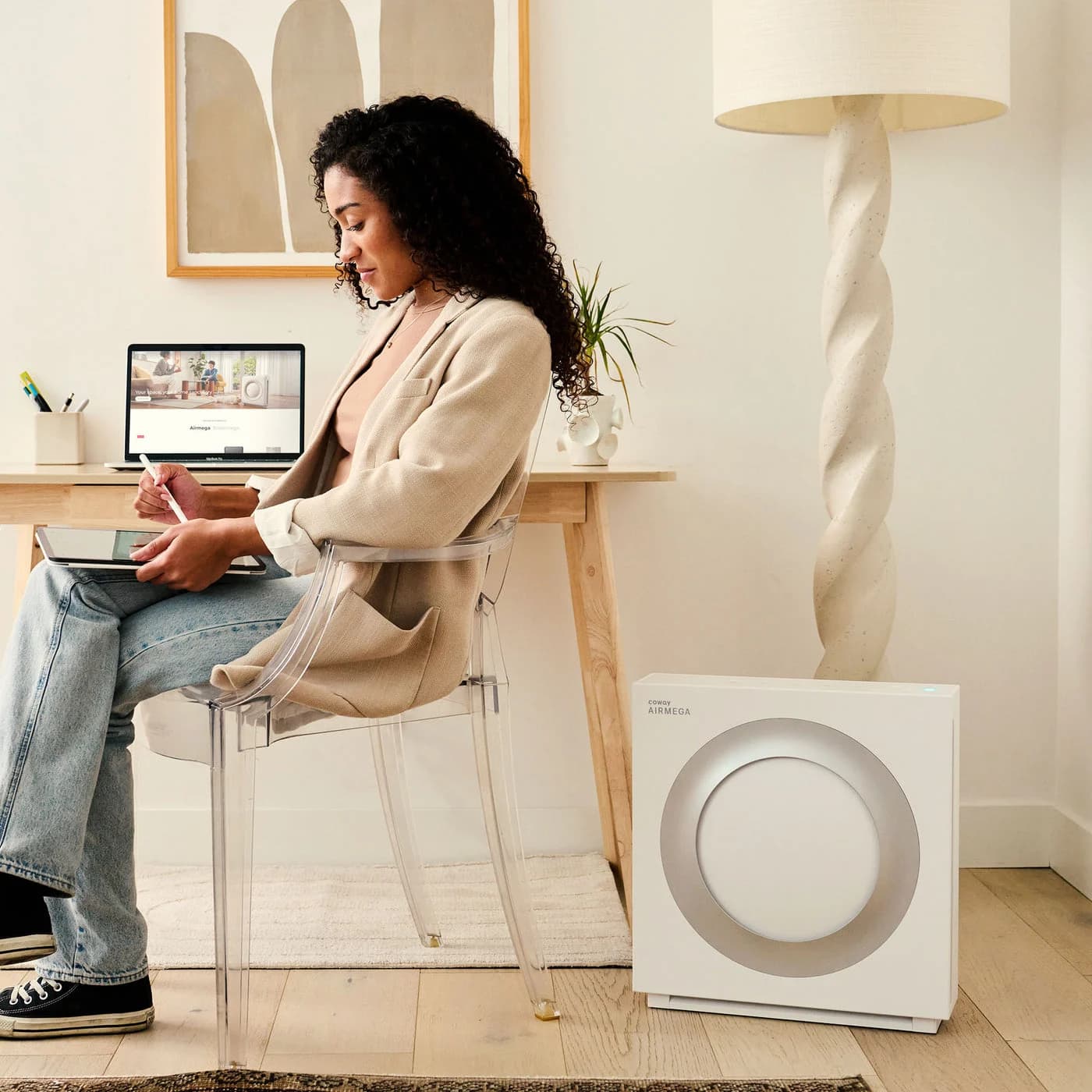
Coway
Coway Airmega Mighty2 AP-1512N
The 2026 successor to Coway's Mighty: smoke CADR 240, a side-access pre-filter plus a combined carbon and HEPA filter, a PM1/2.5/10 laser sensor, and a purely mechanical design with no ionizer.
Check package and model options
- 240 CFM smoke CADR
- Removable pre-filter + Max2 filter (activated carbon + HEPA)
- 19 dB lowest setting
Check the model: white and beige are Mighty2 colours; the original Mighty AP-1512HH has separate deodorization and HEPA filters plus a bipolar device. Do not transfer its filter arrangement to AP-1512N. Coway's documentation also needs careful reading: the product page gives 1,800 sq ft at one air change per hour, while the manual's coverage note states a two-air-change basis. Neither should be presented as a 4.8-air-change room rating. Mighty2 manual, original Mighty
Best for larger rooms: Blueair Blue Pure 211i Max
Choose the 211i Max when you need its higher published smoke CADR of 435 CFM and 674 sq ft rating at 4.8 air changes per hour. HEPASilent combines mechanical and electrostatic filtration; choose the documented filter approach deliberately.
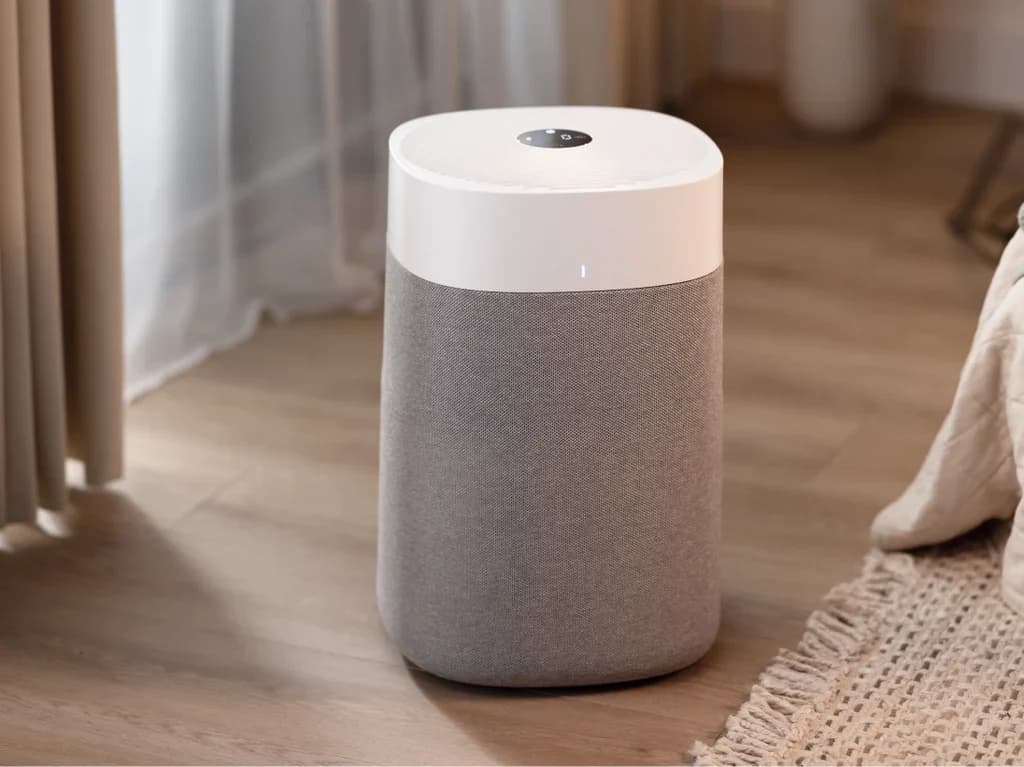
Blueair
A large-room purifier with a 360-degree intake, a washable fabric pre-filter, PM1/PM2.5/PM10 sensing and app control, rated by Blueair at smoke CADR 435 and 674 sq ft.
Check package and model options
- 435 CFM smoke CADR
- 674 sq ft room
- Washable fabric pre-filter + particle and carbon filter (HEPASilent: mechanical plus electrostatic)
- 23 dB lowest setting
Check the filter package: the standard purifier includes a Particle & Carbon filter; SmokeBlock is a different filter option. Blueair says its CADR and area figures were updated for new DOE standards, so packaging can differ. Even Blueair's own text needs care: its specification table says 4.8 air changes per hour, but its FAQ says “4 times every 12.5 minutes.” Use the explicitly labeled specification table; the FAQ wording is inconsistent. Blueair specifications and FAQ
Best small smart option: Levoit Core 300S-P
Choose this for VeSync schedules in a room that fits Levoit's 219 sq ft rating at 4.8 air changes per hour. Its published CADR is 141 CFM, without a pollutant label; we leave smoke CADR unspecified. Its 22–50 dB range does not establish how much air it filters at the quietest setting.
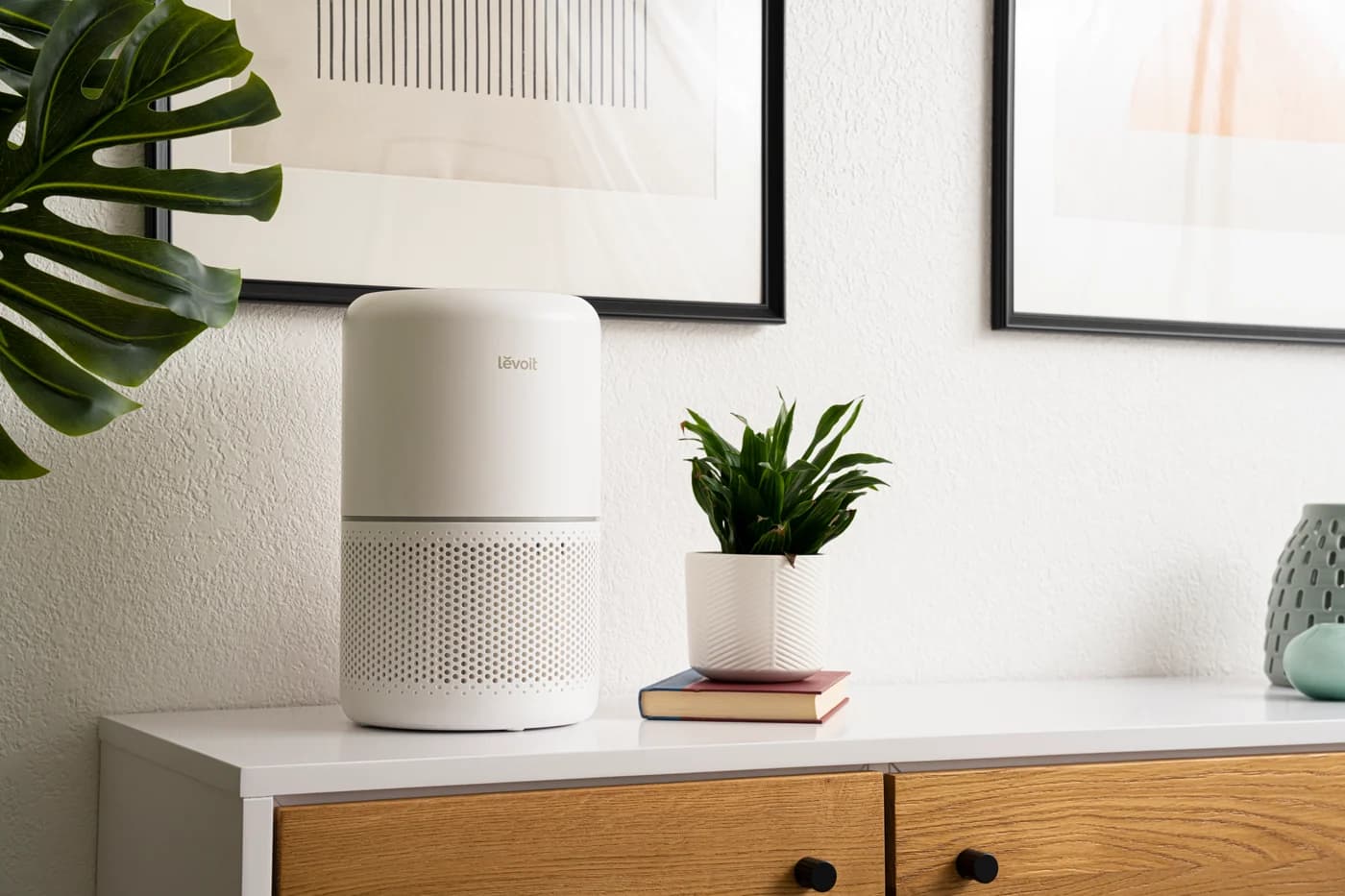
Levoit
A compact Wi-Fi purifier with a 3-stage filter, sleep mode and app or voice control, sized by Levoit at 219 sq ft on the 4.8-air-change basis.
Check package and model options
- 219 sq ft room
- 3-stage filter (Levoit's 'Original' filter; the page does not call it True HEPA)
- 22 dB lowest setting
Check the name: Levoit titles the page Core 300S-P but identifies the model as Core 300S in its specifications. The separate Core 300-P page identifies model Core 300 and lists different ratings. The smart model includes an Original filter already installed; verify the filter contents before choosing a bundle. Smart model, Core 300-P
Which buying guide next?
- Airborne dust: compare CADR and filter upkeep in our pet-home purifier guide; keep cleaning surfaces.
- Smoke: compare smoke CADR in the general air purifier guide; assess gas removal separately.
- Bedroom: compare quiet air purifiers for bedrooms with fan speed in mind.
- Unsure which model: start with best air purifiers by room size.
How we choose
We researched official manufacturer pages and manuals, EPA filtration guidance and AHAM's rating explanations. We have not conducted physical product testing. Recommendations reflect documented particle filtration and practical upkeep; odour capacity and CADR at quiet settings remain unestablished where the cited documents do not supply them.
We could not independently confirm individual AHAM listings for this guide; the comparison uses maker CADRs. Specifications and wording were checked November 2, 2026. See our research method.
Verdict
Buy a purifier for airborne particles after checking the served room, usable speed and filter upkeep. The Coway Mighty2 is our starting choice for its washable pre-filter and combined filter; choose Blueair 211i Max for higher airflow or Levoit Core 300S-P for small-room app schedules. For settled dust, damp or a persistent source of smells, address the source before expecting filtration to finish the job.
Official sources
- EPA: consumer guide, HEPA definition, moisture guidance.
- AHAM: certification and CADR, air-change explanation.
- Oransi: standards and gas-test documentation. CARB: certified-device directory.
- Manufacturers: Coway Mighty2, Blueair 211i Max, Levoit Core 300S-P.
Our picks at a glance
- 1
Coway Airmega Mighty2 AP-1512N
Choose for: Mechanical filtration with a washable pre-filter and one combined carbon/HEPA replacement.
Limit: Smoke CADR is maker-rated at 240; the cited specifications do not state units. No AHAM or ENERGY STAR listing was confirmed.
- 2
Choose for: A larger-room purifier with automatic controls and app schedules.
Limit: HEPASilent includes an electronic filtration stage; choose a mechanical-only purifier if you want to avoid that stage.
- 3
Choose for: Automatic controls and app schedules for a smaller room.
Limit: Its 219 sq ft claim uses 4.8 air changes per hour; the headline 1,051 sq ft uses just one. Match the room-size basis.
Frequently asked questions
Do air purifiers work for dust?
They can capture dust suspended in the air, provided enough room air passes through the filter. Filtration acts on that air; it does not wipe shelves or vacuum the floor. Our buying rule is to compare particle CADR and the room rating for airborne dust, while keeping surface cleaning as a separate job. Buy for the dust the filter can reach.
Do HEPA air purifiers remove smells?
HEPA addresses particles. Gaseous odours need activated carbon or another medium designed for the gas involved. EPA says carbon can be effective when a large amount is used, but particle CADR does not rate gas removal. A filter described as containing carbon therefore establishes the material, without establishing how much odour it will remove or for how long.
Is True HEPA better than HEPA-type?
Do not assume the labels are equivalent. EPA describes HEPA using a theoretical capture efficiency of at least 99.97% at 0.3 microns. Compare the exact filter documentation with that benchmark and ask for the complete purifier's CADR. Our rule is to require evidence beyond the word True: an added word does not supply a room-size rating or independent model verification.
How long does an air purifier take to work?
There is no universal countdown. EPA says higher fan speeds and longer operating times increase filtration, while effectiveness depends on the room and airflow. AHAM's suggested room size uses 4.8 equivalent air changes per hour; that is a clean-air delivery basis, not a promise that every particle disappears after one cycle. Check the rating at the speed you intend to use.
Will an air purifier fix a musty room?
It may capture some airborne particles or reduce some odours, but EPA says air cleaners do not resolve the moisture problem behind mold and musty smells. Find and address the water source first. EPA's advice is to get rid of the moisture source and clean up the growth. Buy filtration only for a remaining airborne-particle problem, rather than as the solution to damp.
Related guides
Best picks · Air Purifiers
Best Air Purifiers for Smoke: Wildfire Sizing and Filter Checks
Choose an air purifier for wildfire smoke by confirmed smoke CADR, room size and filtration type, with exact filter checks and EPA's DIY alternative explained.
Best picks · Air Purifiers
Best Air Purifiers for Dust: CADR, Room Size and Filter Upkeep
Choose an air purifier for airborne dust with separate dust and smoke CADR, clear room sizing, accessible pre-filters and exact replacement parts for each pick.
Comparison · Air Purifiers
Levoit vs Coway: Vital 200S-P vs Airmega Mighty2
Choose between Levoit Vital 200S-P and Coway Mighty2 by room sizing, filter cleaning, app schedules and bedroom lights, with specification gaps explained.